Ming Dynasty Court Dress — Empress’s Daily Attire

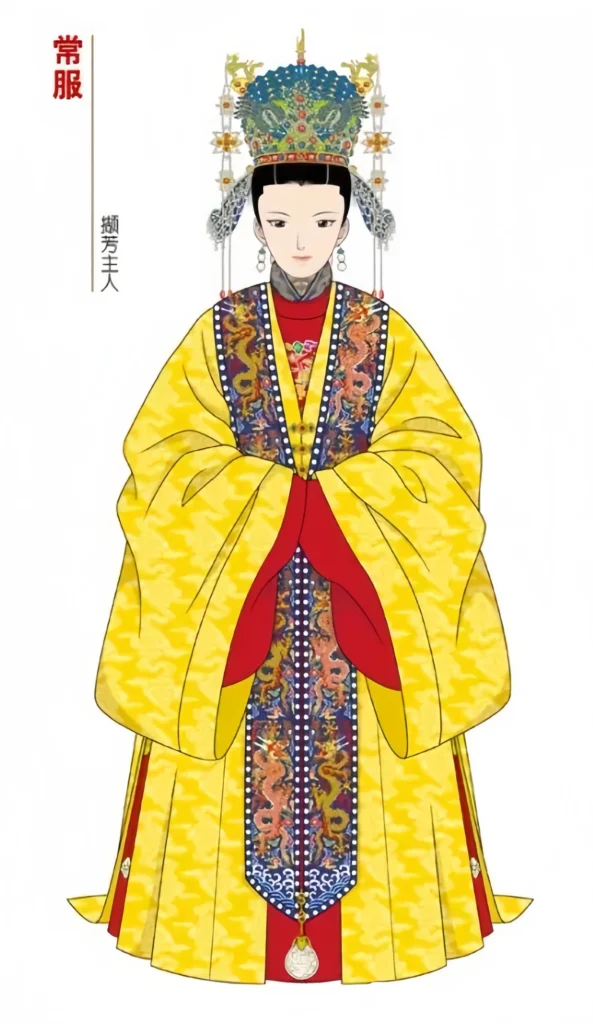
The Ming empress daily attire was also known as Yanji Crown Attire, featuring the iconic Ming phoenix crown. In function, it ranked just below formal ceremonial dress and was used in various ritual settings. For example, after an empress’s formal investiture ceremony, once the thanksgiving rites were completed in full ceremonial dress, she would return to the palace, change into Yanji attire, and receive congratulations from female relatives, the Six Palace Offices’ women officials, and eunuchs from the palace bureaus. This elegant Ming empress daily attire highlights the sophistication of Ming queen dress traditions.
The system of Ming empress daily attire went through multiple revisions. In the first year of Hongwu, the empress’s Yanji attire was defined as including the Double Phoenix Supporting Dragon Crown, multicolored round-patterned robes, and gold-and-jade belts. In the fourth year of Hongwu, this was revised to include a Dragon-and-Phoenix Pearl and Kingfisher Crown, a bright red wide-sleeved robe, and a xiapei. According to the Yongle-era regulations recorded in the Ming Hui Dian, the empress’s daily attire consisted of the Double Phoenix Supporting Dragon Crown, a large robe, a xiapei, and a ju garment.
Double Phoenix Supporting Dragon Crown
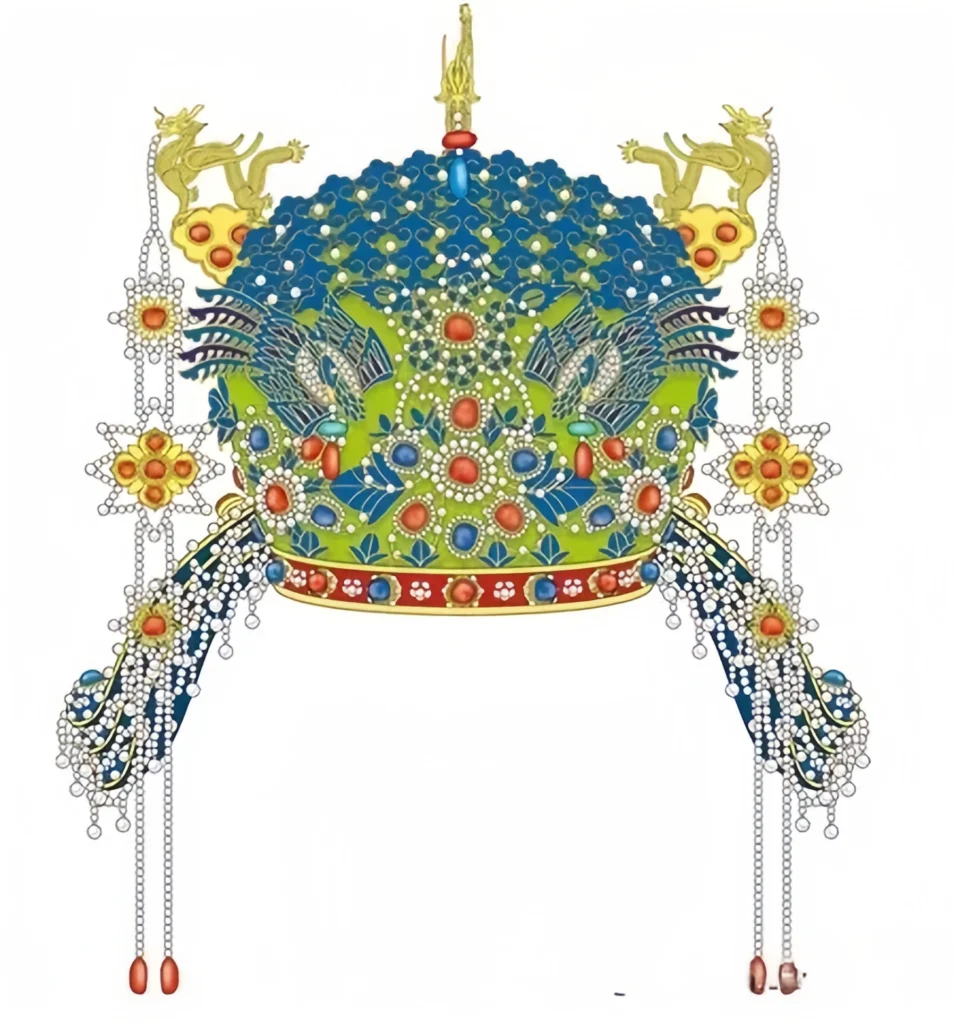
This crown served as the empress’s Yanji crown, a distinctive Ming phoenix crown often referred to as a Ming Hanfu crown in traditional contexts. The Ming Hui Dian provides a detailed description of its structure:
“The Double Phoenix Supporting Dragon Crown is made of black gauze, with kingfisher-feather Boshan ornaments attached. At the top is a single golden dragon, flanked by two pearl-and-kingfisher phoenixes, each holding a pearl drop in its beak. At the front and back are two pearl peony flowers, each with eight stamens, thirty-six kingfisher leaves, and two pearl-and-kingfisher flower buns at the temples, along with twenty-one pearl-and-kingfisher cloud pieces.
A pair of kingfisher-edged mouth rings is attached, decorated with nine gold treasure flower plaques, each set with a pearl. A pair of golden phoenixes holds pearl knots in their beaks. There are three boside ornaments on each side (six in total), decorated with luan and phoenix motifs, twenty-four gold treasure plaques, and dangling pearl drops along the edges. One pair of gold hairpins is included, along with one pair of coral phoenix beaks.”
Compared with the ceremonial phoenix crown, the Yanji crown is smaller and usually only covers the hair bun. The crown body is covered with black crepe gauze, and Boshan-shaped bases decorated with kingfisher feathers are attached, overlaid with pearl-and-kingfisher cloud motifs. At the center of the top sits a golden dragon, flanked on each side by a kingfisher (or gold) phoenix, each holding pearl or gemstone drops in its beak.
Pearl peony flowers are attached to the front and back of the crown, complete with stamens and kingfisher leaves. Pearl-and-kingfisher floral ornaments are placed at both sides of the crown. At the base is a kingfisher-edged mouth ring decorated with gold plaques and pearls. A pair of golden phoenix hairpins is inserted at the top of the crown, with long pin shafts standing upright downward; each phoenix holds a string of pearls forming a pearl knot, a feature not found on ceremonial crowns.
Six boside ornaments are attached at the back, three on each side, decorated with luan and phoenix motifs, gold plaques, and dangling pearl drops. Another pair of gold hairpins is inserted at the base of the crown to secure it to the hair bun. The exact location referred to as the “coral phoenix beak” remains unclear.
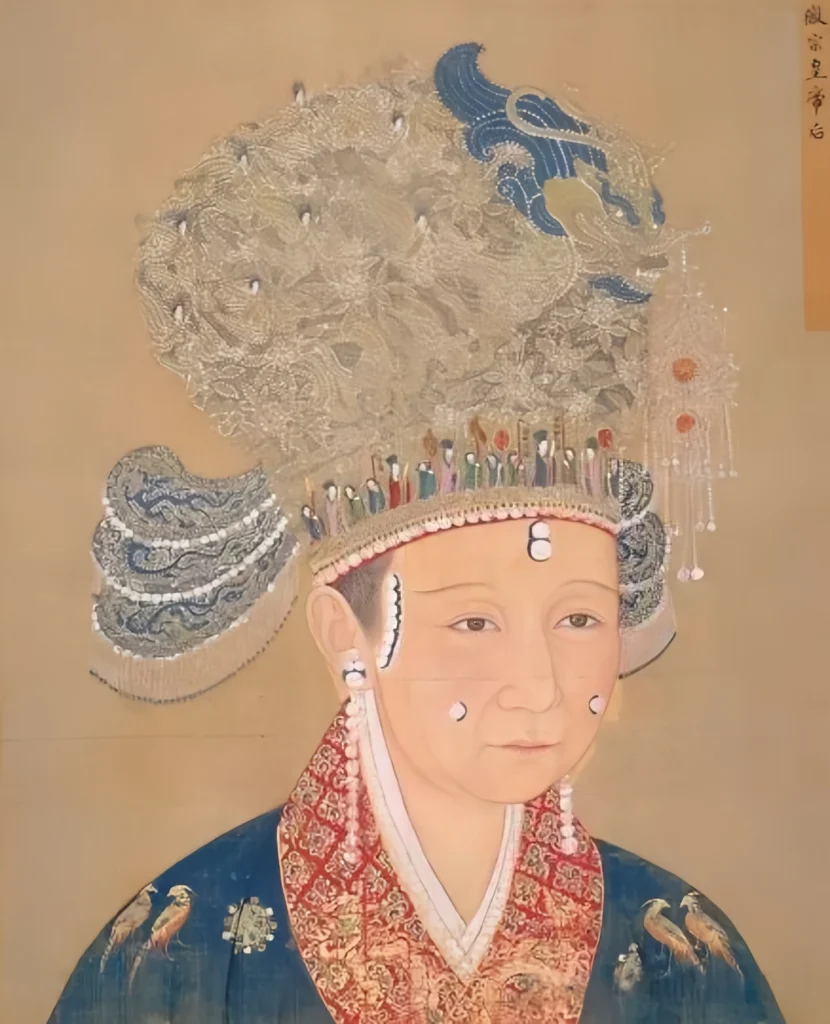
Surviving portraits of Ming empresses from different periods show that the decorative details of the Double Phoenix Supporting Dragon Crown changed over time – a key part of Ming Hanfu crown evolution.
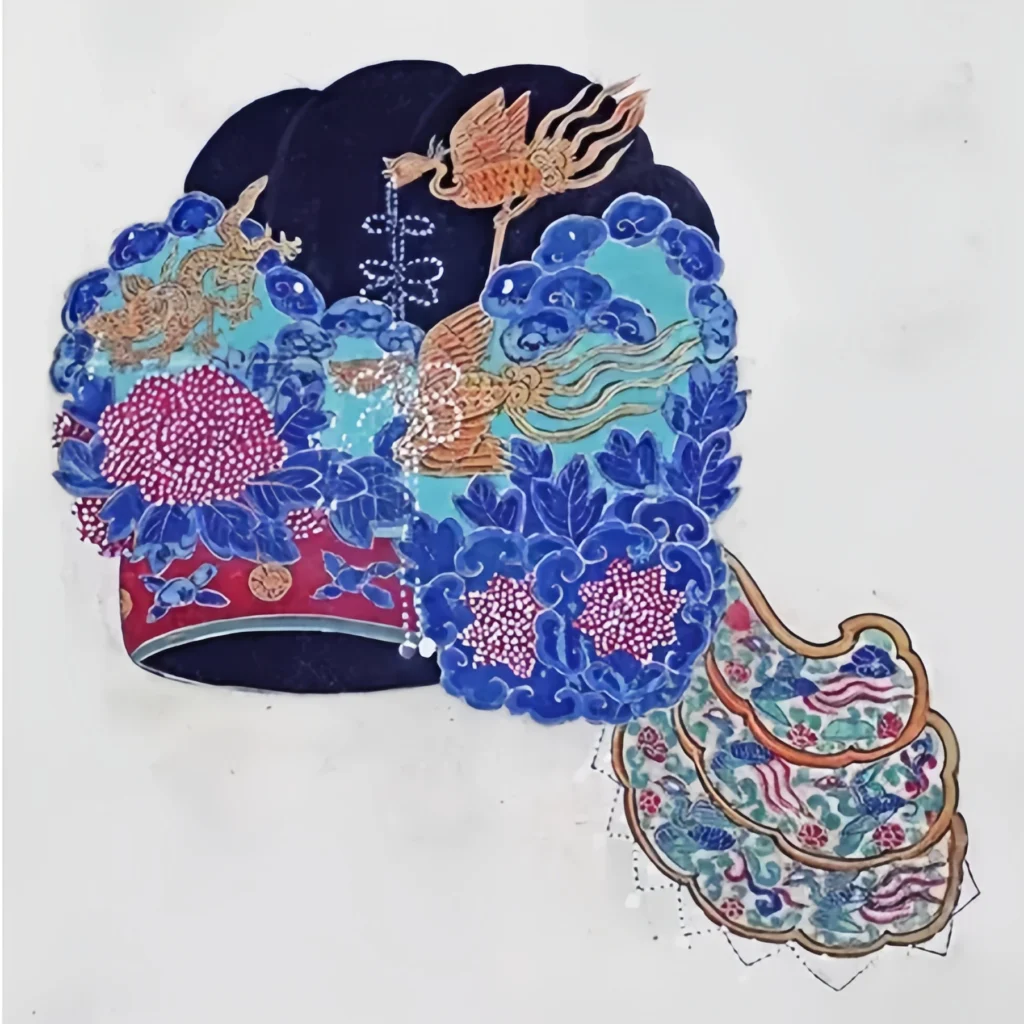

Empress Xiaozhenchun (early-mid period)
Empress Xiaojingyi (mid period)
Empress Xiaochun (late period)
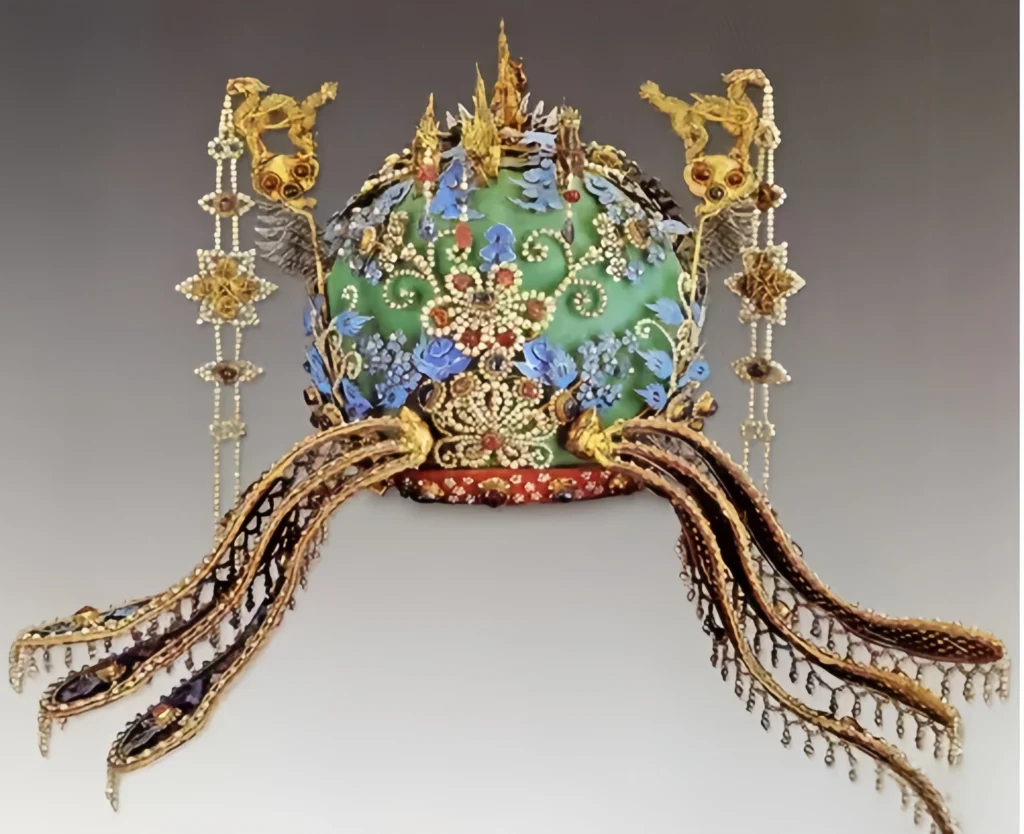
Two Yanji crowns were excavated from the Dingling tomb of Emperor Wanli: the Six Dragon Three Phoenix Crown of Empress Xiaoduanxian and the Three Dragon Two Phoenix Crown of Empress Xiaojing. Both belong to the late Ming style and exemplify the evolution of the Ming phoenix crown. Among them, the Three Dragon Two Phoenix Crown is closer to the institutional description of the Double Phoenix Supporting Dragon Crown.
The Three Dragon Two Phoenix Crown of Empress Xiaojing measures 31.7 cm in height and 34 cm in upper width, with an outer diameter of 19 cm and an inner diameter of 17 cm. The inner structure is a circular crown frame made of lacquered bamboo strips, with a gilded metal ring along the rim. The crown top is decorated with one golden dragon, while the front features two kingfisher phoenixes, all holding red and blue gemstone drops in their beaks, with pearls densely covering the phoenix backs.
A pair of golden dragon hairpins is inserted at the sides, each holding a long pearl knot divided into two strands. At the center hang three gold-bead flowers, with chrysanthemum-shaped motifs above and below, each set with gemstones. The middle section features a peony-shaped flower set with five gemstones, and the ends are finished with pairs of red gemstones.
The crown is covered with eighty pieces of kingfisher cloud motifs. Four large pearl flowers (all peonies) are placed at the front and back, each set with seven red and blue gemstones and seven kingfisher leaves. Six smaller pearl flowers (all plum blossoms) are also attached, each with one gemstone and four kingfisher leaves, except the topmost flower, which has twelve leaves.
The boside ornaments are arranged in three panels on each side. Each panel is decorated with a golden dragon, a kingfisher cloud, two gemstones, and hanging pearl networks and drops. In total, the crown is set with ninety-five red and blue gemstones and 3,426 pearls, with a total weight of 2,165 grams.
Large Robe, Xiapei, and Pendant
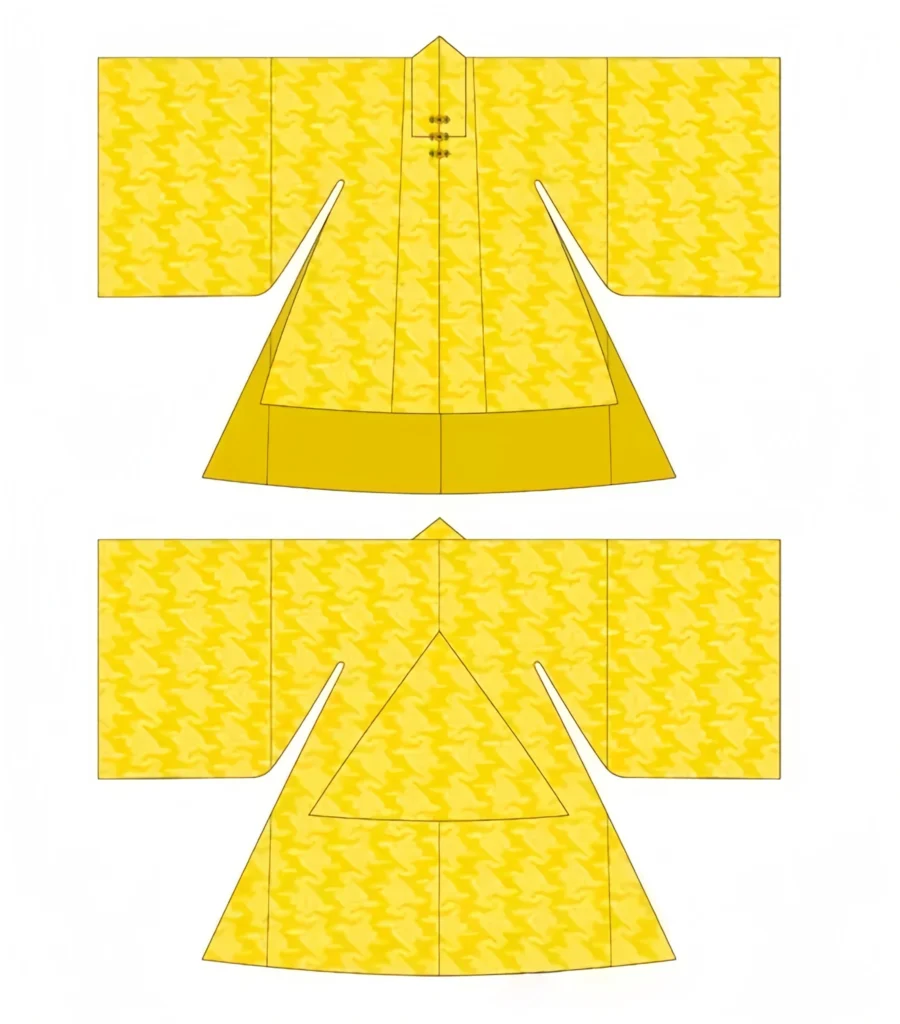
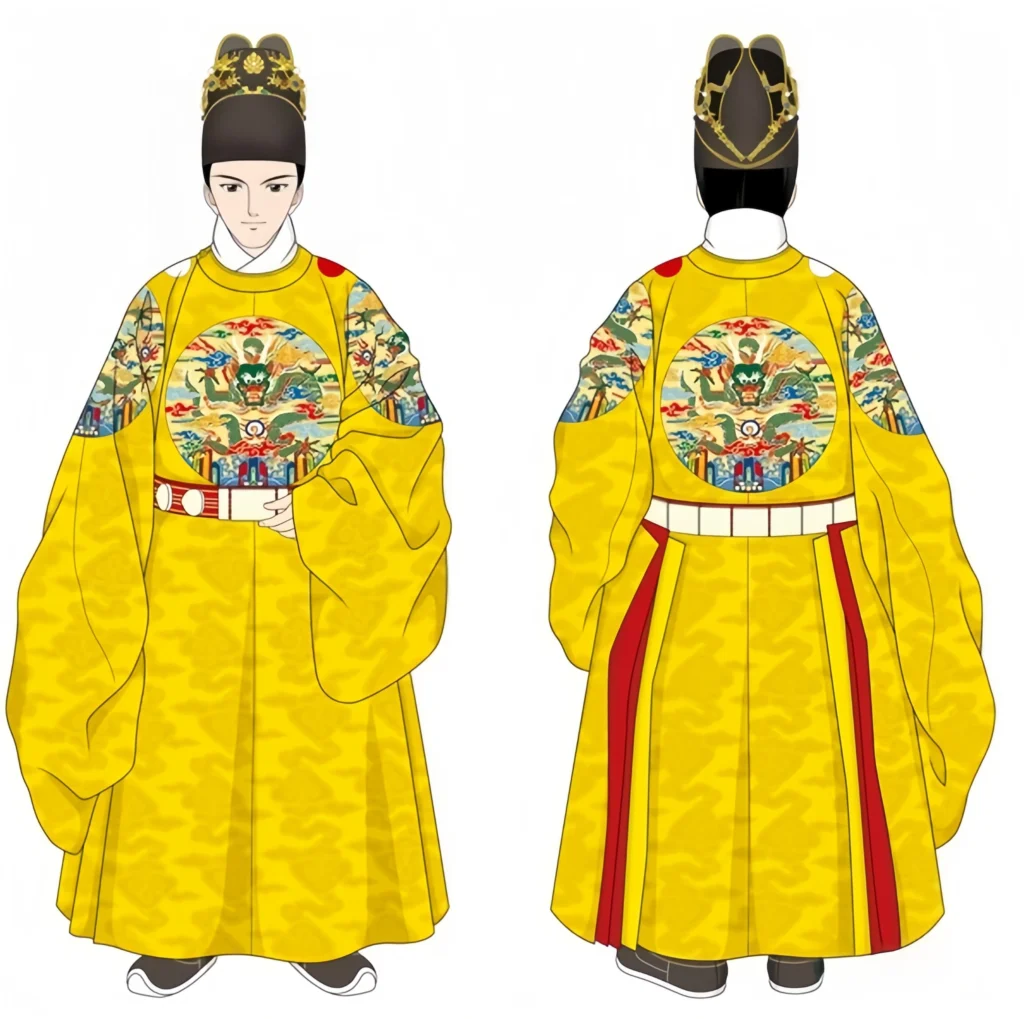
The empress’s large robe is yellow and made from ramie silk, gauze, or luo silk, forming the core of the Ming queen dress within traditional Hanfu dress styles. It has a straight collar, front opening, three pairs of fasteners at the collar, wide open sleeves, and a back panel slightly longer than the front. A triangular pouch is sewn onto the lower back to hold the ends of the xiapei.
A Ming dynasty large robe excavated from the tomb of Lady Wu, consort of the Ningjing Prince in Nanchang, Jiangxi, measures 123 cm in front length and 138 cm in back length. The sleeves span 240 cm, with cuffs 91 cm wide. Slits run up both sides to the underarms. The triangular back pouch measures 104 cm along the base and 59 cm in height, forming a pocket structure. The robe is mainly made from five panels of plain satin, with silk lining along the collar and inner edges. Small loops on both sides of the collar secure the xiapei.

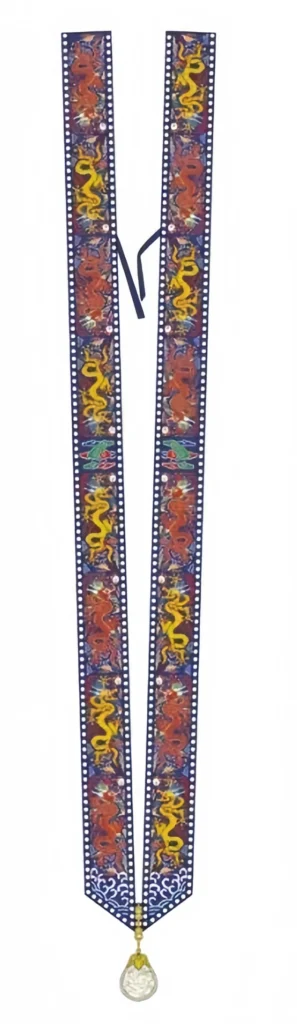
The xiapei consists of two parallel bands, officially designated as deep blue, though early Ming portraits often show red, likely influenced by Song dynasty tradition. The xiapei is decorated with woven or embroidered cloud-and-dragon patterns, sometimes enhanced with kingfisher feathers or gilding. Each band features eight dragons, with pearl or round-bead patterns along the edges.
The front ends are cut into pointed tips and joined together, from which a pendant hangs. The ends extend toward the back and are stored in the robe’s back pouch. A pair of blue silk loops connects the two bands.
The xiapei excavated from Lady Wu’s tomb is made of luo silk, each band measuring 245 cm in length and 13 cm in width. The bands were cut from a single piece of fabric and folded and stitched. Three horizontal loops at the pointed end hold the pendant, while loops and ties along the inner side secure the xiapei to the robe, preventing it from slipping.
Ju Garment
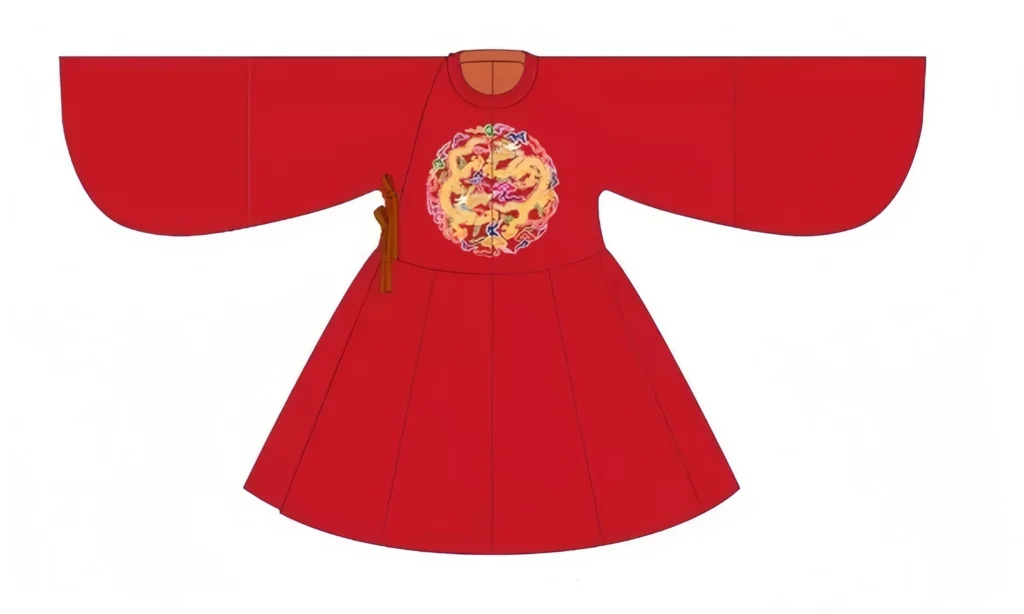
Under the large robe, the empress wore a ju garment. It is red, with a round collar, large lapel, wide sleeves with gathered cuffs, and a lower section composed of twelve panels, modeled after the deep-robe system. Cloud-and-dragon roundels may appear on the chest and back, though plain versions also exist. Materials include ramie silk, gauze, or luo silk – a key part of Ming queen dress.
Classical texts record the ju garment as one of the queen’s six formal garments. In the Ming dynasty, due to the absence of the royal sericulture ritual, the ju garment was repurposed as daily attire and worn together with the yellow large robe, adopting a deep-robe structure but with a round collar.
Beizi Robes and Trimmed Skirt
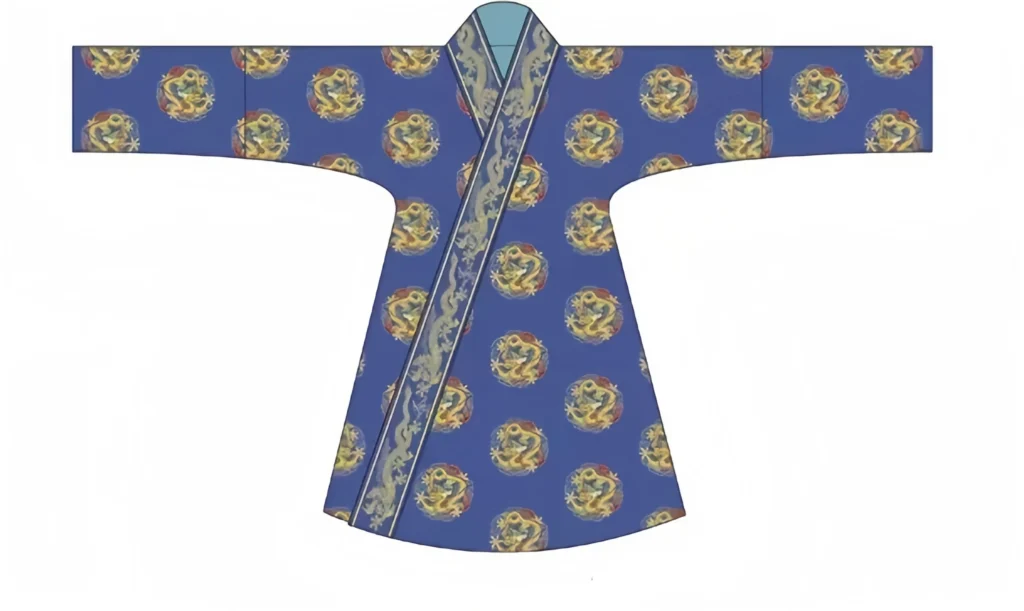
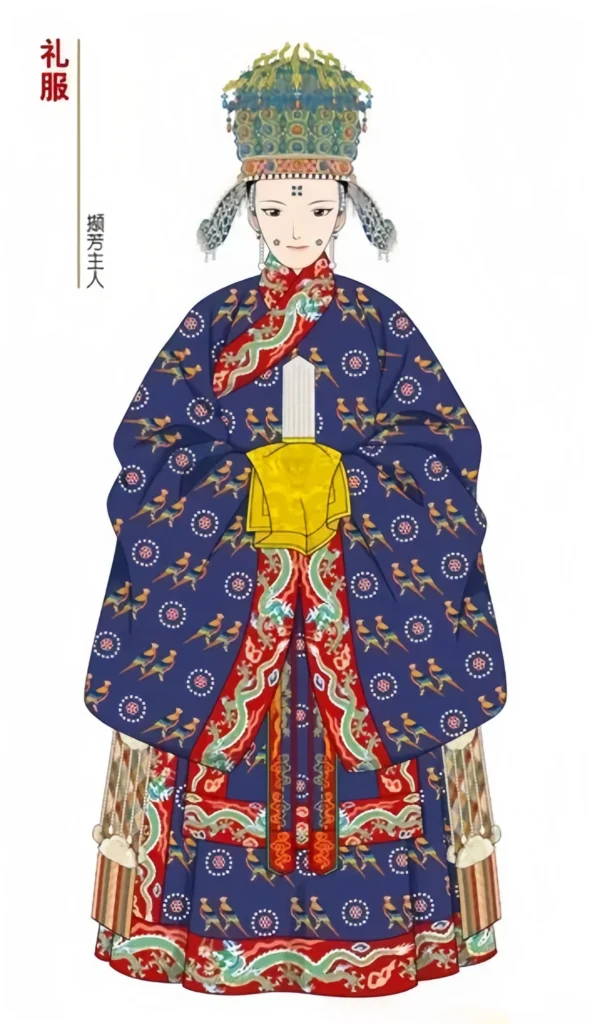
The four-panel beizi robe is deep blue, with narrow sleeves, a straight collar, and a front opening without a center seam. It is worn with the left panel crossing over the right, forming a right-lapped style. The collar is trimmed and decorated with gold cloud-and-dragon motifs, while the body features multicolored round dragon patterns.
The trimmed robe is yellow, with a straight collar and narrow sleeves, worn in the same right-lapped style. Red edging decorates the collar, sleeves, and front, with woven gold cloud-and-dragon patterns. From portraits onward from the reign of Emperor Yingzong, these robes feature vertical collars with gemstone-set gold buttons.
The trimmed skirt matches the structure of what is now known as the mamian skirt. It is red with a white waistband and white ties. The front panel is flat, with dense pleats on both sides extending to overlapping panels at the back. Green-edged borders with woven gold cloud-and-dragon patterns decorate the hem and panels. Similar skirts excavated from Dingling feature elaborate vertical and horizontal borders with dragon, wave, and floral motifs.
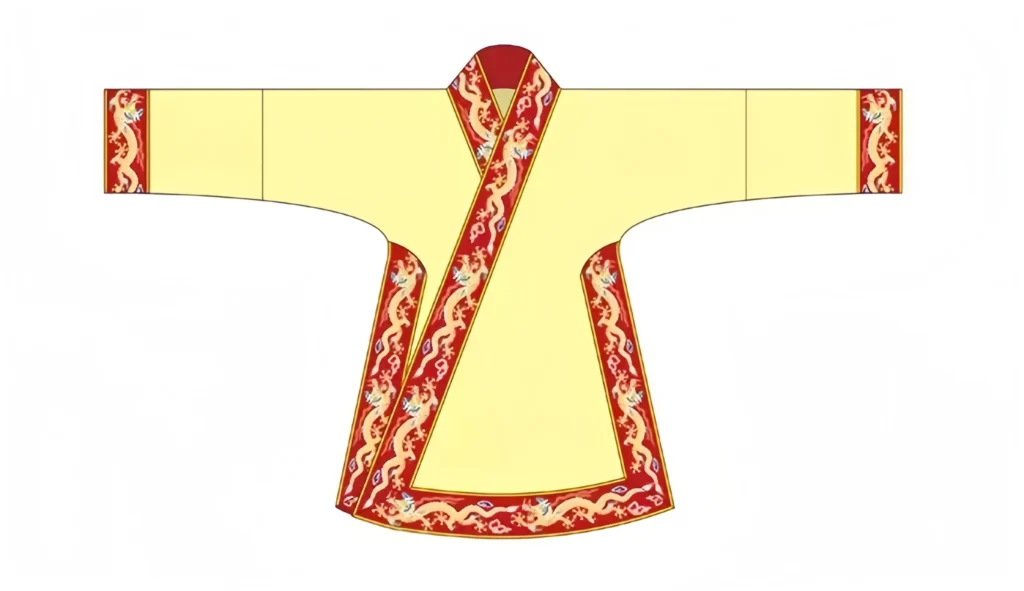
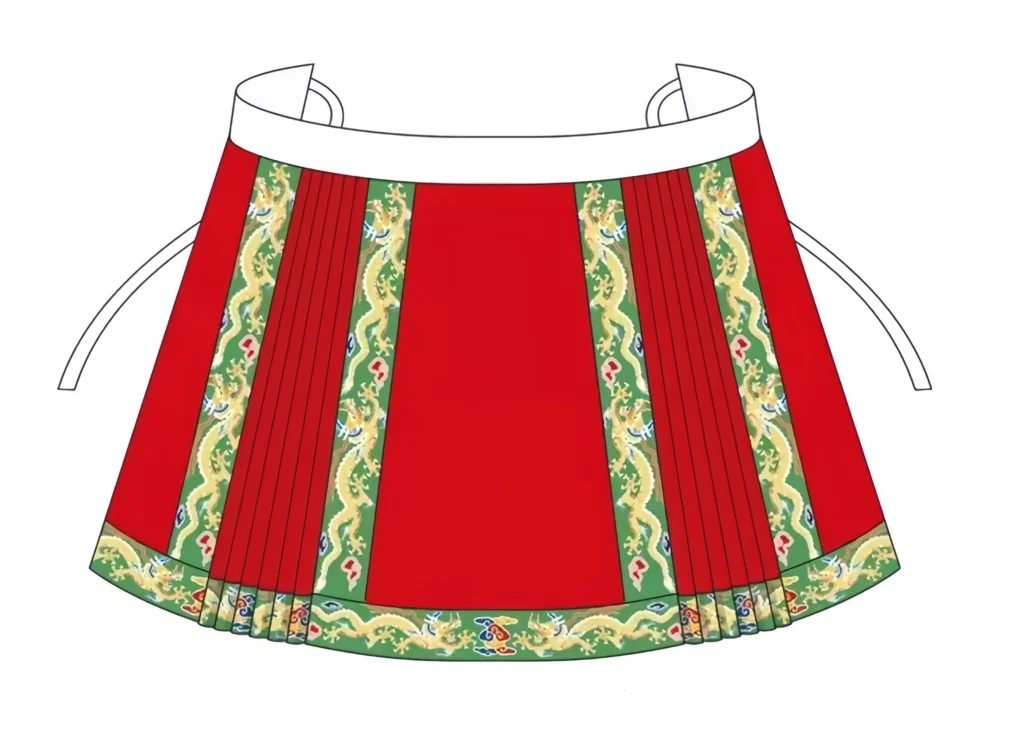
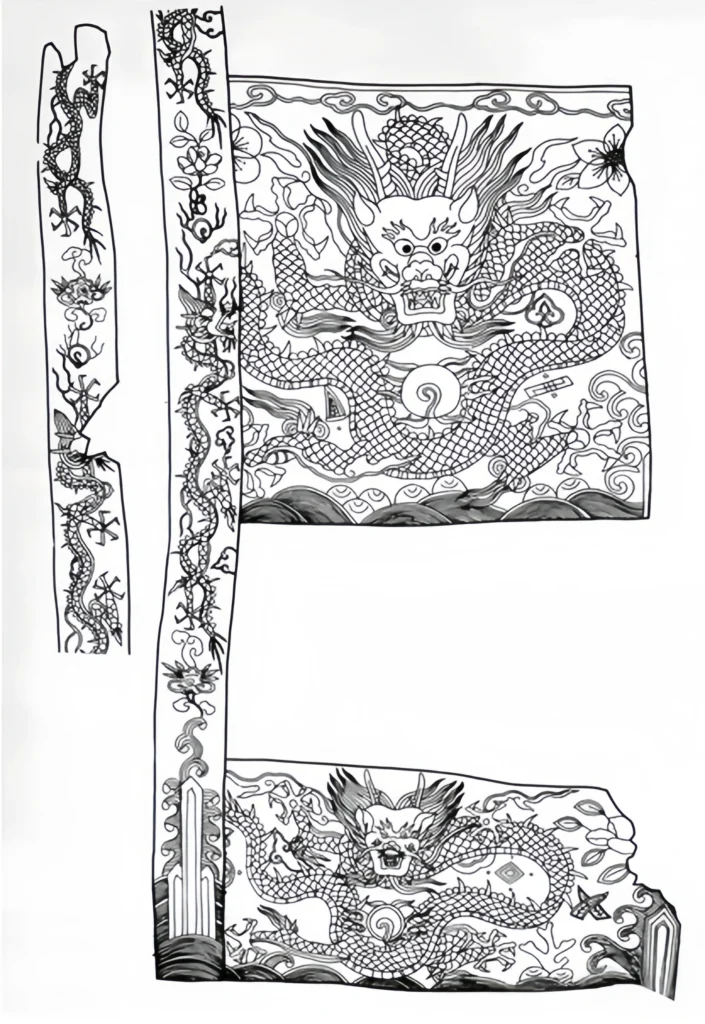
(from the Dingling Excavation Report)
Belts and Jade Belt
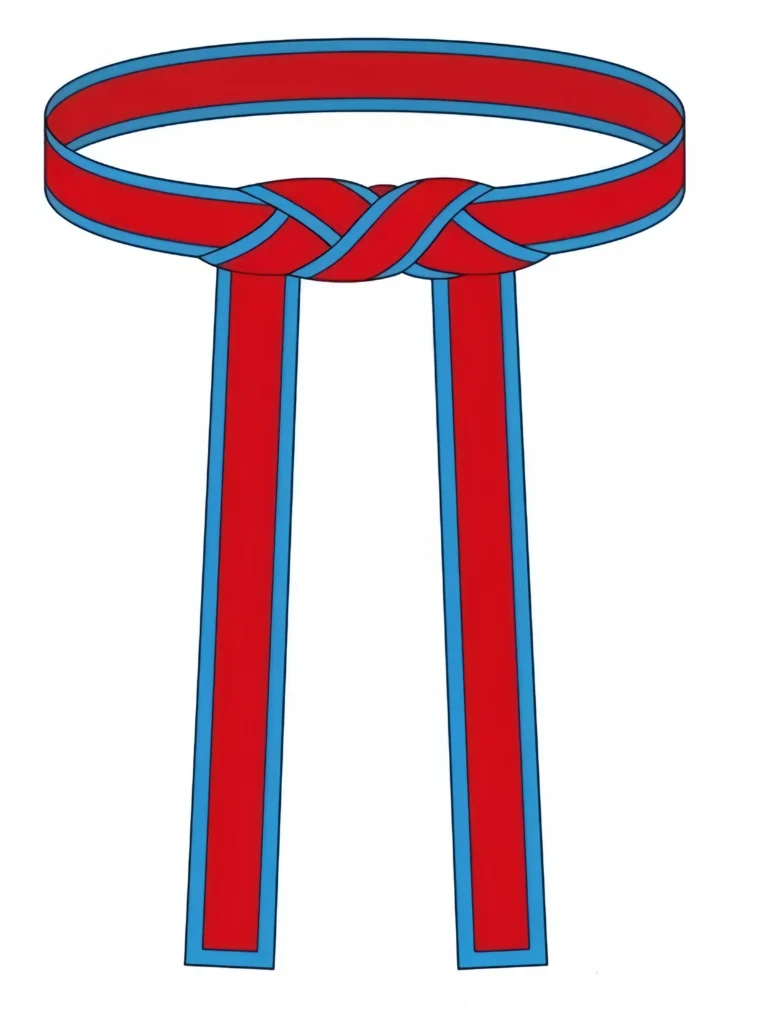
The large belt is worn over the ju garment and made of silk gauze matching the garment color. Illustrations suggest it wraps around the waist, ties at the front, and hangs down.
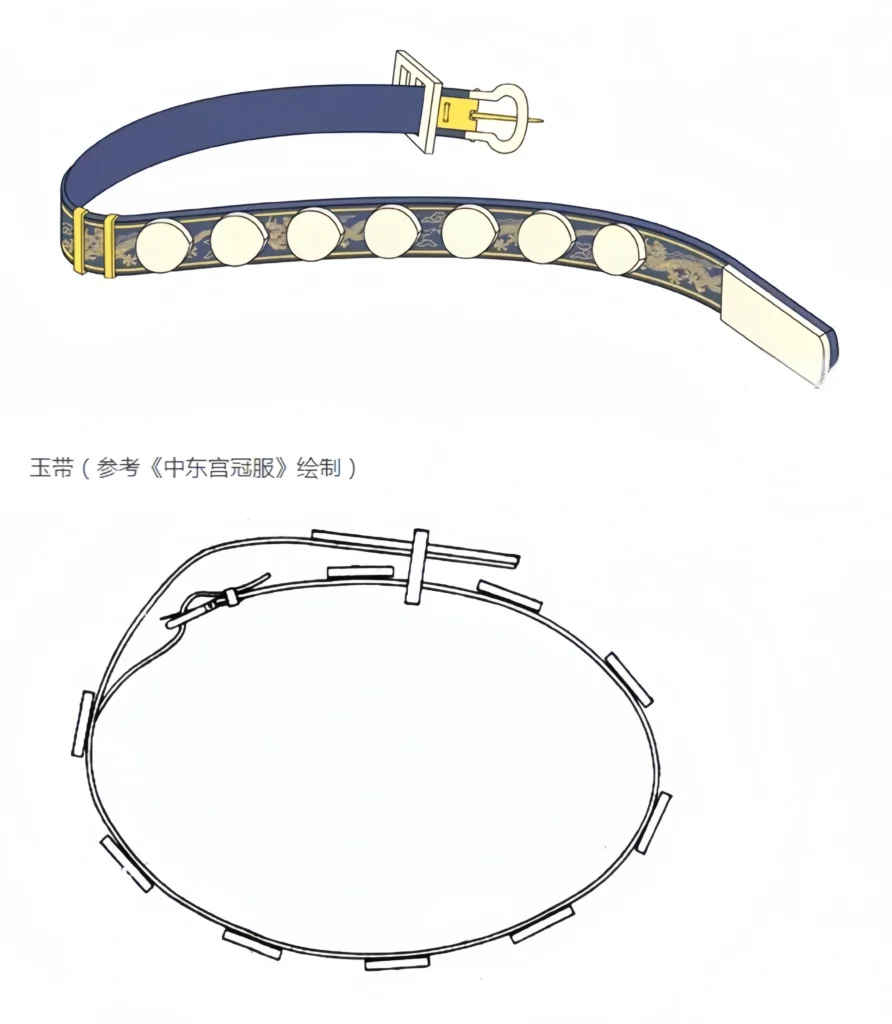
The jade belt, or leather belt, follows the same structure as ceremonial belts, wrapped in blue silk and decorated with gold cloud-and-dragon patterns. Excavated examples show adjustable inner straps and jade fittings, suggesting use with Ming empress daily attire.
Jade Knotted Sash and Jade Pendants
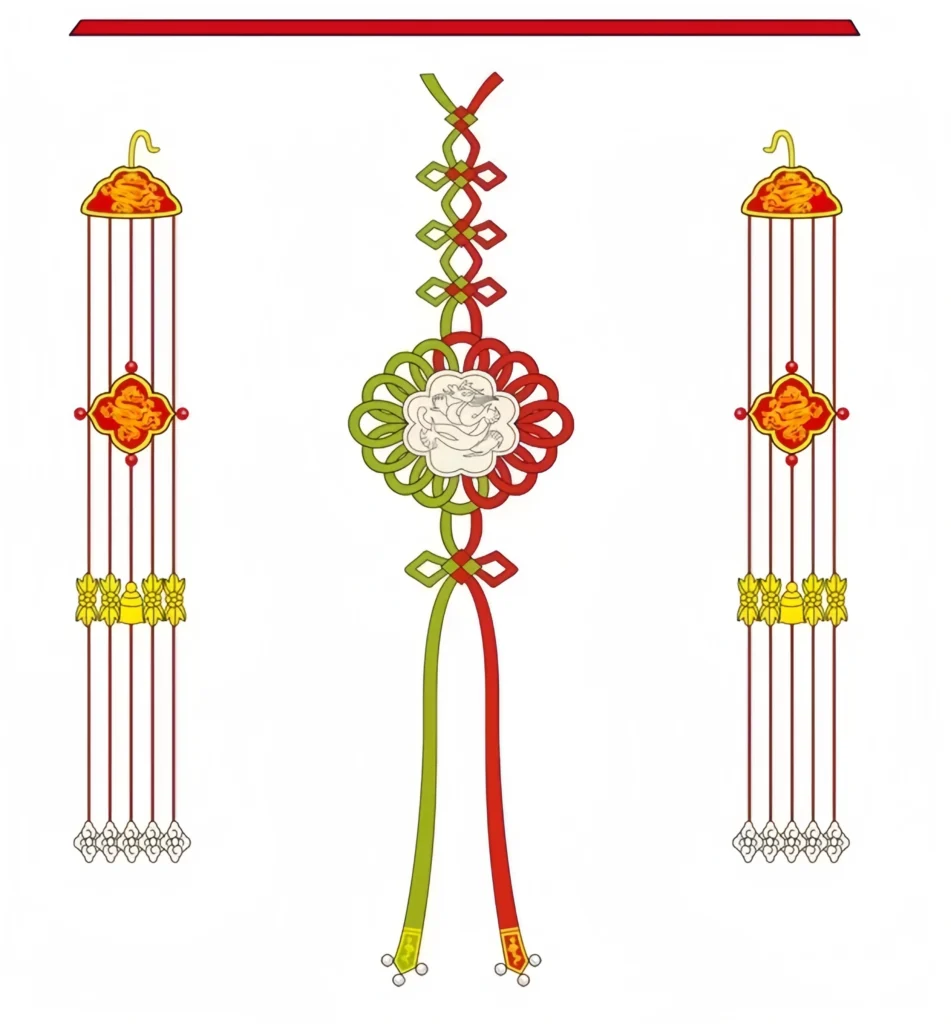
The jade knotted sash is woven from red and green silk, centered with a jade plaque carved with cloud-and-dragon motifs. Gold plaques, jade beads, and leaf-shaped ornaments hang below. A red silk tie secures the sash beneath the belt.
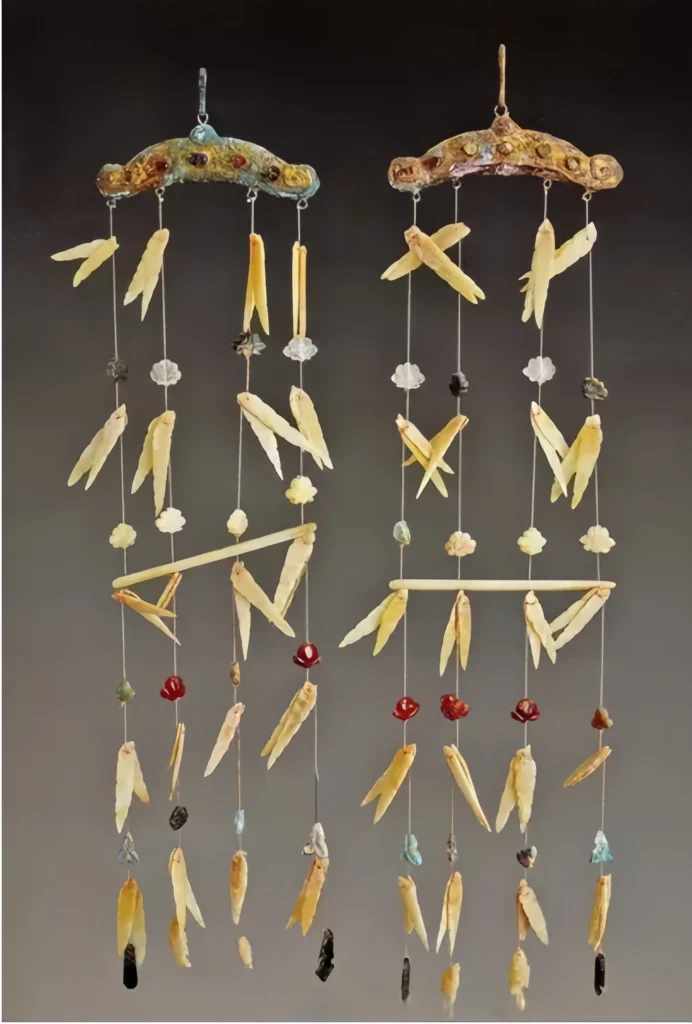
The white jade cloud pendants are worn as a pair, with gold hooks, cloud-shaped covers, engraved motifs, red silk cords, and jade cloud drops. Later Ming examples excavated from Dingling represent more elaborate developments of this form, complementing the Ming Hanfu crown.
Socks and Shoes
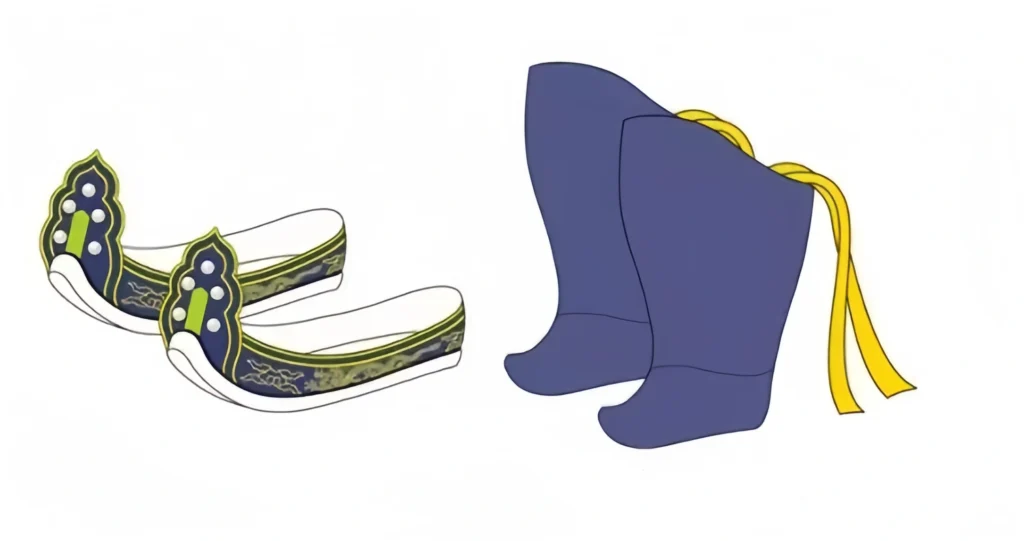
The Ming empress daily attire includes blue socks and blue xi shoes, identical in structure to those used with formal dress.
Origins and Development
The Ming empress daily attire system, including the renowned Ming phoenix crown and Ming queen dress elements rooted in Hanfu dress traditions, was based largely on Song dynasty precedents. Song records describe similar garments, including wide-sleeved robes, xiapei, and jade pendants. Ming regulations established in the fourth year of Hongwu closely followed Song models, later undergoing significant revisions to suit Ming court needs. Over time, these changes formed a distinctive and mature system unique to the Ming dynasty, influencing modern interpretations of Ming Hanfu crown and overall Hanfu dress revival, as seen in contemporary Hanfu dress enthusiasts drawn to the Ming queen dress aesthetic.
Love Ming court fashion?
Check our Ming Hanfu styling guide for authentic tips!


Responses