Ming Dynasty Court Dress — The Emperor’s Military Attire

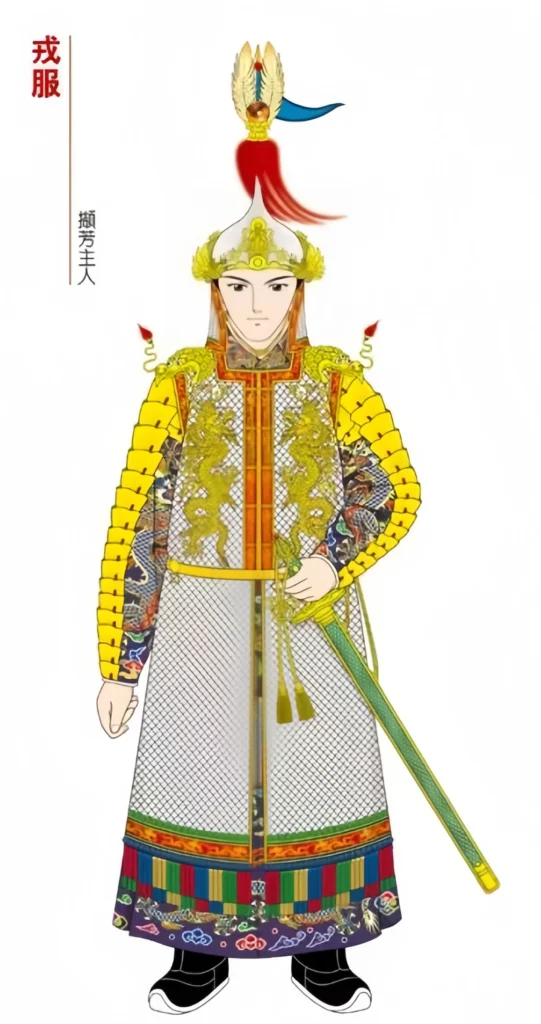
In the Ming Dynasty, emperors wore Ming emperor military attire during hunting expeditions, horseback travel, and important military or ceremonial martial events. However, the Ming clothing system did not list the emperor’s Ming emperor military attire as a separate category, so detailed records of its types, structures, and functions are limited.
The armor excavated from the Dingling Tomb of the Wanli Emperor is currently the only known physical example of Ming dynasty armor. In addition, Ming paintings such as Imperial Procession Under Guard, Emperor Xuanzong on the Hunt, and Emperor Xuanzong Shooting on Horseback depict emperors wearing Ming emperor military attire. By combining these visual sources with archaeological finds and historical records, we can gain a general understanding of Ming emperors’ Ming emperor military attire. Today, many Ming Dynasty Hanfu recreations draw inspiration from these practical designs, blending historical accuracy with modern wearability.
Zhaojia (Over-Armor Vest)
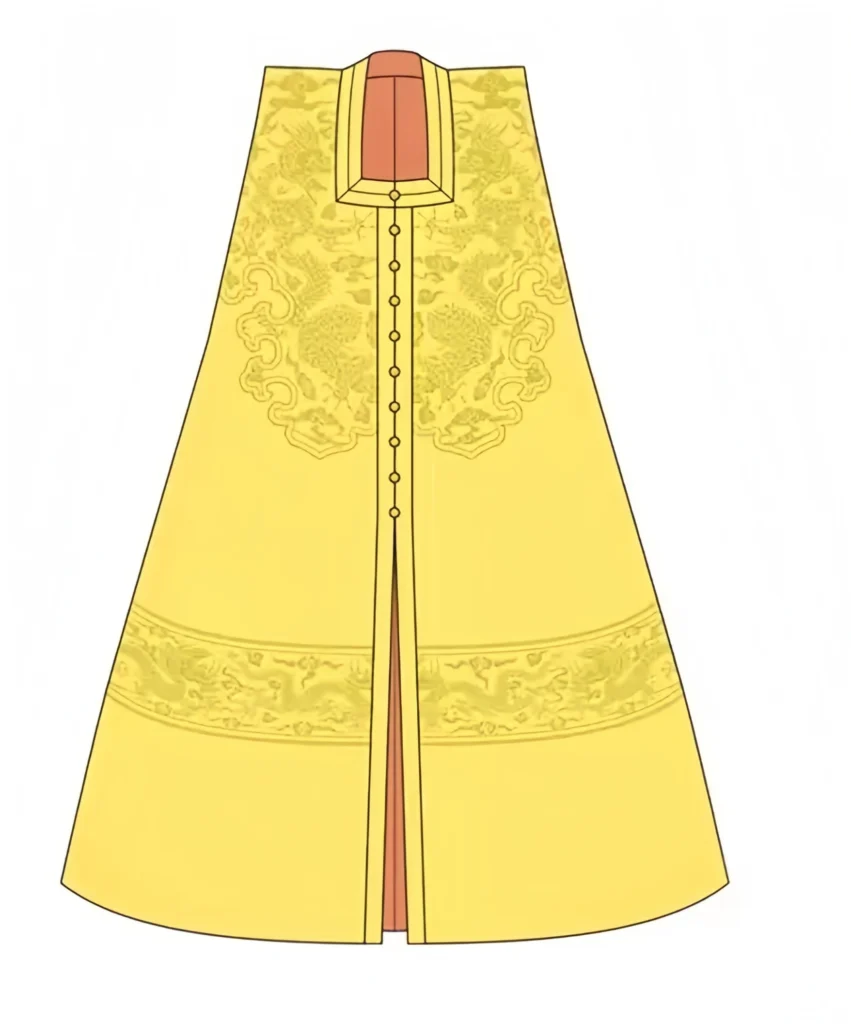
Zhaojia was the most common form of Ming zhaojia armor in the Ming Dynasty. Structurally, it was front-opening, with either a square or round collar, sleeveless, and slit at the sides and sometimes at the back to allow ease of movement, especially for horseback riding.
In real combat, Ming zhaojia armor used on the battlefield usually had metal armor plates attached either on the inside or outside for protection. Ming zhaojia armor used in ceremonial processions focused more on decoration and often featured only metal studs on the outer surface. For everyday activities such as riding and hunting, Ming zhaojia armor were made entirely of fabric, lightweight and practical, resembling long sleeveless vests – a style that influences some modern Hanfu attire for active wear.
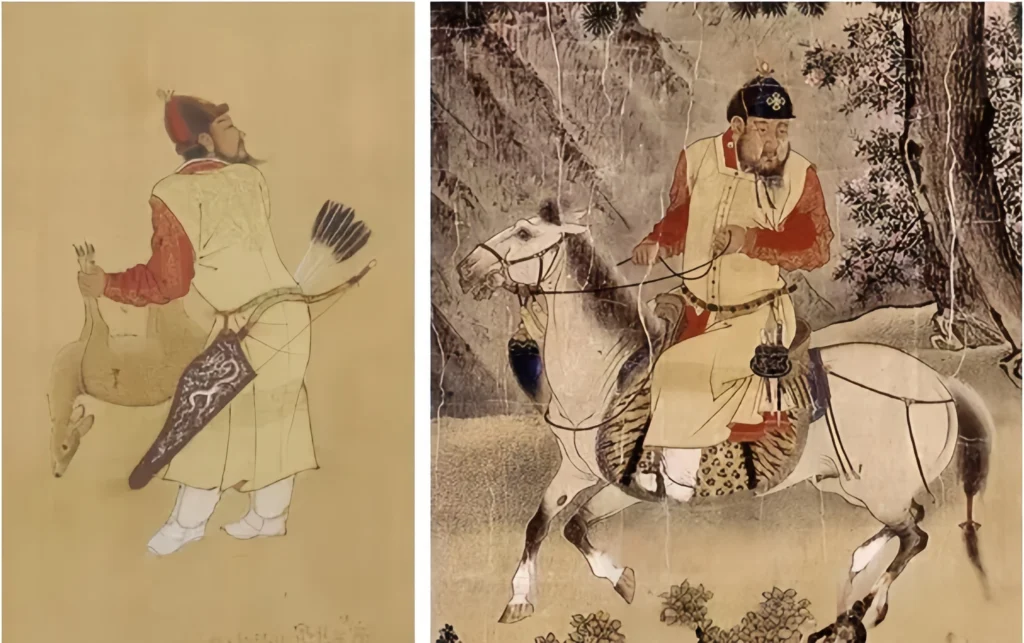
The Palace Museum collections Emperor Xuanzong on the Hunt by Shang Xi and Emperor Xuanzong The Palace Museum collections Emperor Xuanzong on the Hunt by Shang Xi and Emperor Xuanzong Shooting on Horseback both depict Emperor Xuanzong (Zhu Zhanji) hunting outdoors. In both paintings, the emperor wears nearly identical Ming emperor military attire: a fur hat known as a Dada hat (also called a fox-fur hat), a yellow front-opening zhaojia with a square collar, without armor plates or studs. The garment is decorated with cloud-collar motifs and cloud-and-dragon knee panels, with a row of small round buttons along the front opening.
Under the zhaojia, the emperor wears a red narrow-sleeved robe with a crossed collar. Its exact structure is unclear, but based on attendants’ clothing, it was likely a zhishen-style robe. A narrow leather belt is fastened at the waist, similar in form and fittings to everyday belts, from which hang a bow case, quiver, gourd pouch, small knife, and toothpick case.
Liu Ruoyu’s Zhuo Zhong Zhi from the late Ming records: “Zhaojia, worn over narrow-sleeved military garments and secured with a narrow belt, all belong to military dress.” This description matches the Ming emperor military attire shown in the paintings.
Due to its practicality, fabric-made Ming zhaojia armor gradually became popular among civilians. In the sixteenth year of the Zhengde reign, an imperial ban was issued prohibiting both soldiers and civilians from wearing ‘purple-flower zhaojia’, which were made from purple cotton cloth. This fabric, woven from purple kapok, had a light yellow-brown tone.
The Ming painting Imperial Procession Under Guard is a grand handscroll depicting the imperial procession traveling from the capital to the Changling Tomb at Tianshou Mountain. In this scene, the Wanli Emperor rides a tall horse, wearing Ming emperor military attire that appears more imposing and ceremonial than that of Emperor Xuanzong.
In the painting, the emperor wears a gilded phoenix-wing helmet, with a gold figure of Zhenwu (the Perfected Warrior) on the front. On either side are fire-breathing golden dragons with spread wings shaped like phoenix wings. The helmet is topped with red plumes, feathers, and banners, and the back features a protective neck guard with attached armor plates.
He wears a zhaojia with a square collar, front opening, sleeveless design, and slits at both sides and the back. The front is fastened with date-pit-shaped gilt clasps and fabric loops. The entire surface is covered with overlapping fish-scale armor plates, with a rising golden dragon on each side of the chest. The collar, shoulders, front edges, and hem are all bordered with red woven or embroidered cloud-and-dragon patterns, with a notably wide lower border.
The shoulders are protected by golden beast-head shoulder guards, adorned with red tassels. The front and back hems are decorated with double rows of multicolored fringes in red, blue, yellow, and green. Based on the shape of the armor plates, this Ming dynasty armor likely corresponds to the “fish-scale leaf bright armor” described in the Collected Statutes of the Ming Dynasty. As it extends lower than waist-length armor, it is also known as long-body great armor.
Under the zhaojia, the emperor wears a narrow-sleeved robe decorated with multicolored cloud-and-dragon patterns. His arms are fitted with arm bindings made of gold plates strung with red cords, allowing freedom of movement. A yellow belt is worn at the waist, from which hang a sword, bow case, and quiver.
Qiyao Armor (Waist-Length Armor)
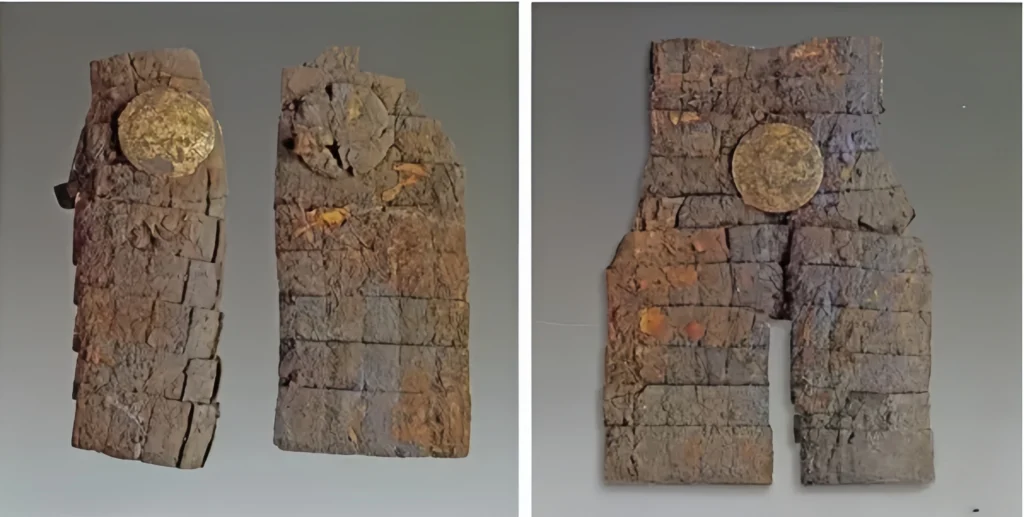
The Dingling Tomb yielded a complete set of Ming dynasty armor, along with a belt, saber, bow case, and quiver. The materials, structure, and decoration closely match descriptions found in the Collected Statutes of the Ming Dynasty, making them invaluable physical evidence for studying Ming emperor military attire.
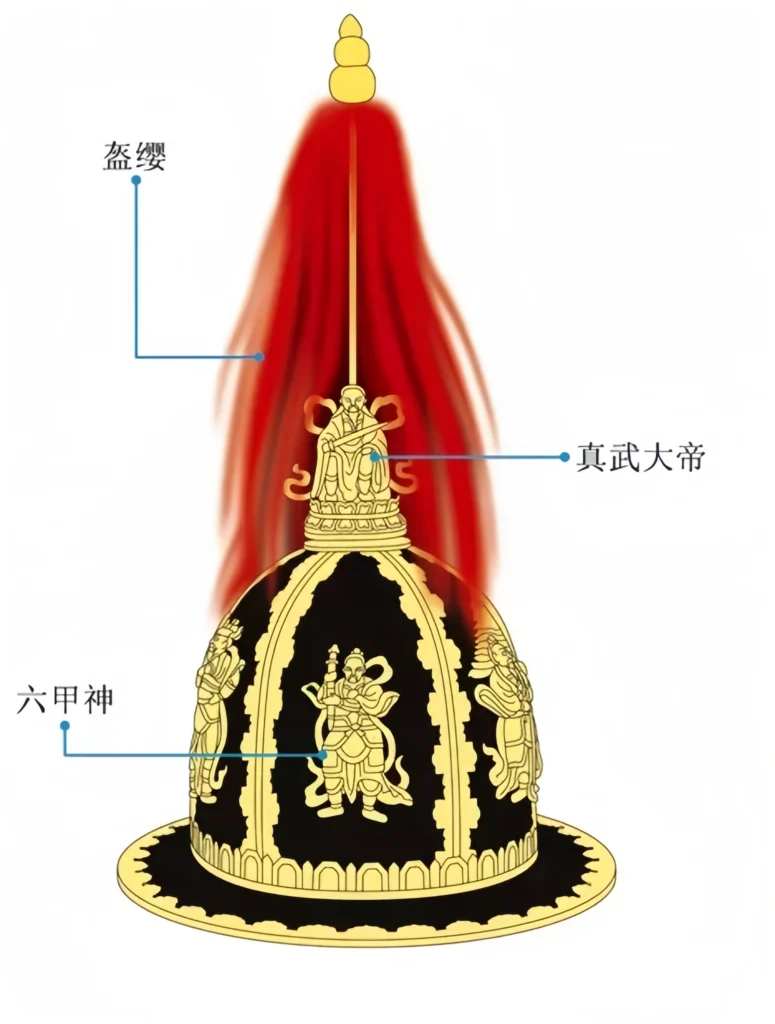
Iron Helmet
Height: 33 cm. The helmet has a rounded dome with a wide flat brim. The top is assembled from six iron plates joined with iron strips, covered externally with gilt aromatic-grass patterned seams. Six gilded Six Jia Deities are inlaid on the helmet surface.
At the junction of the brim and dome, lotus-petal gilt seams are applied. Forty-five small pearls remain along the front edge, likely decorative. At the top sits an inverted lotus pedestal supporting a gilt statue of Zhenwu, dressed in a Daoist robe over armor, barefoot and holding a sword. Three gold tubes are welded to the back to hold plumes and banners. The interior is lined with plain yellow silk.
The Collected Statutes records a “gilt iron helmet with aromatic-grass seams and six-petal construction,” which closely matches this artifact.
Iron Armor
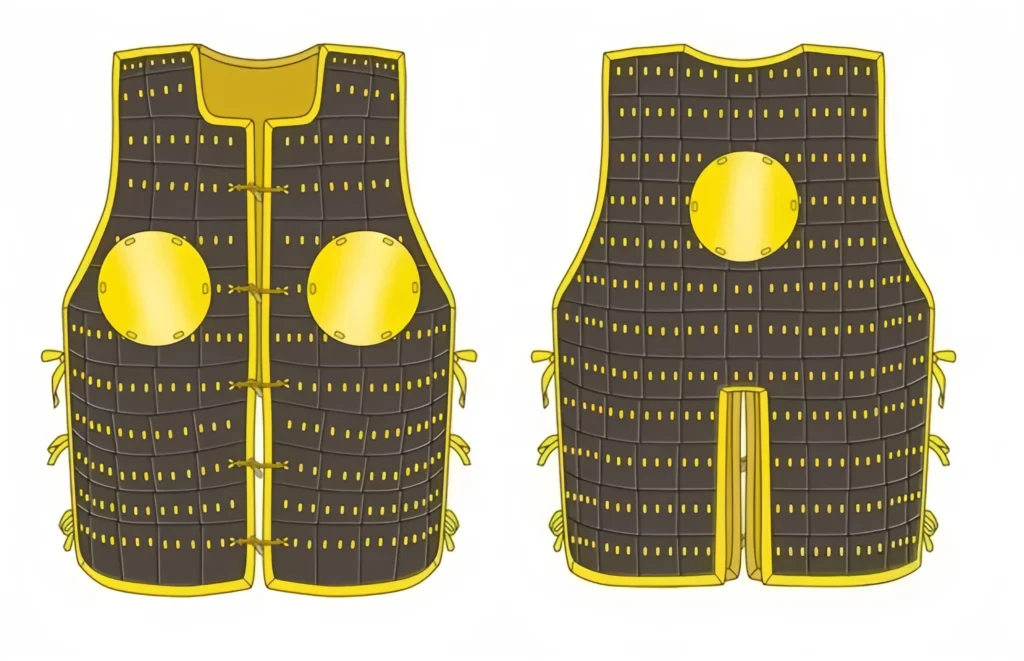
The armor is vest-shaped, with a square collar, front opening, and no shoulder flaps. Total length from shoulder to hem is 68 cm. The front consists of two panels, each with a gilt iron round mirror guard at chest level, fastened with six pairs of date-pit-shaped clasps. The back panel is a single piece with a central round guard and a slit at the lower section.
The Ming dynasty armor is composed of 199 black-lacquered iron plates—square and triangular—laced together with thick silk cords and lined with woven gold brocade. The Collected Statutes mentions armor types such as “waist-length bright armor strung with red cords,” which closely resemble this set.
Tiao Belt (Weapon Belt)
The belt is made of yellow silk and was found attached to a bow case. The center section features four floral-shaped gilt copper belt eyes, with three round gilt plates on each side. Square hooks hang below for suspending weapons such as bow cases, quivers, and sabers.
Both ends are fitted with gilt copper fittings shaped like leather belt tails, engraved with dragon patterns. One end includes a hook. The Collected Statutes records large-scale annual production of weapon belts during the Hongzhi reign, indicating that this belt is a saber belt.

Saber
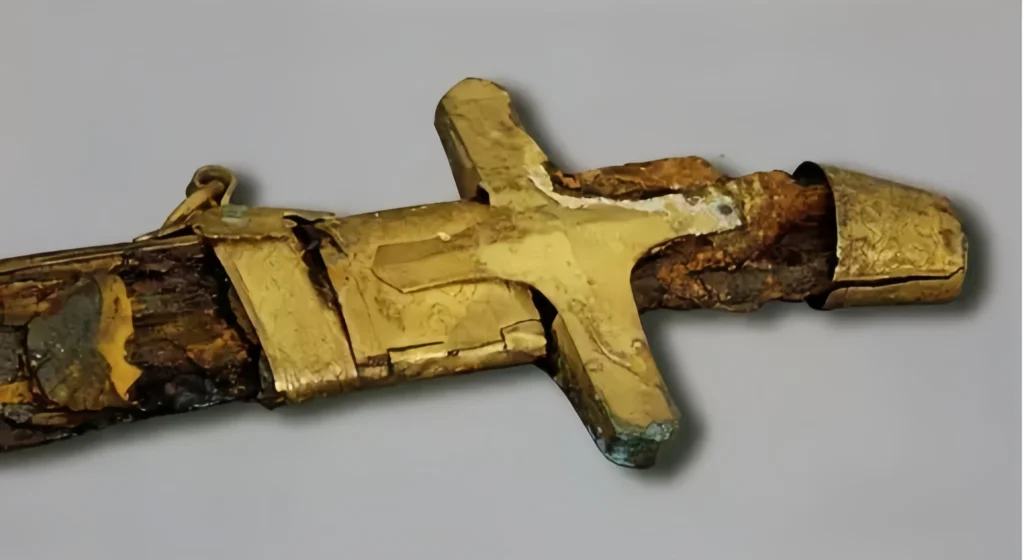
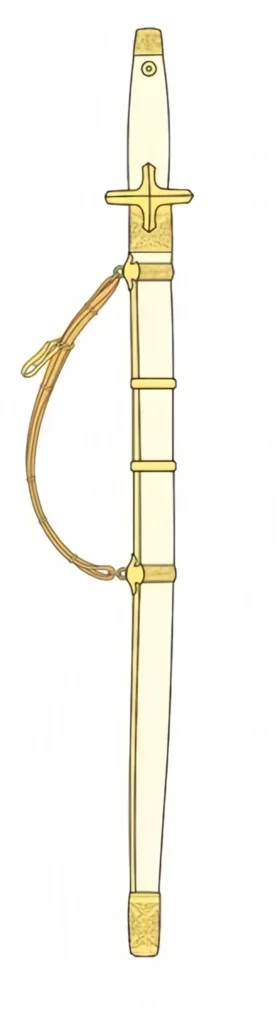
The saber is made of iron, with a long straight blade and a fish-belly edge. The handle has wooden grips and a pommel inlaid with gold cloud-pattern plates, with a gold crossguard. The wooden scabbard is covered with sharkskin and lacquered red, with gold fittings engraved with cloud-and-dragon motifs.
Total length (with scabbard): 95 cm; width: 4.2 cm.
Historical Records of Imperial Military Dress
The Ming Veritable Records include several accounts of emperors wearing Ming emperor military attire. In the thirteenth year of the Zhengde reign, Emperor Wuzong rode swiftly in military dress, lost control of his horse, and was briefly detained by patrol soldiers. The attire described likely resembled Xuanzong’s hunting outfit, emphasizing functionality.
In the third year of the Longqing reign, Emperor Muzong reviewed troops at the capital training grounds, wearing Ming emperor military attire on a raised platform. This attire was likely similar to the ceremonial style worn by the Wanli Emperor in Imperial Procession Under Guard, emphasizing visual authority and imperial dignity while maintaining a martial presence.
Love Ming Dynasty Hanfu recreations?
Check our Ming Hanfu styling guide for authentic tips!

Responses