Ming Bestowed Robes — Dou Niu Robes, Flying Fish Robes, Mang Robes, and Qilin Robes

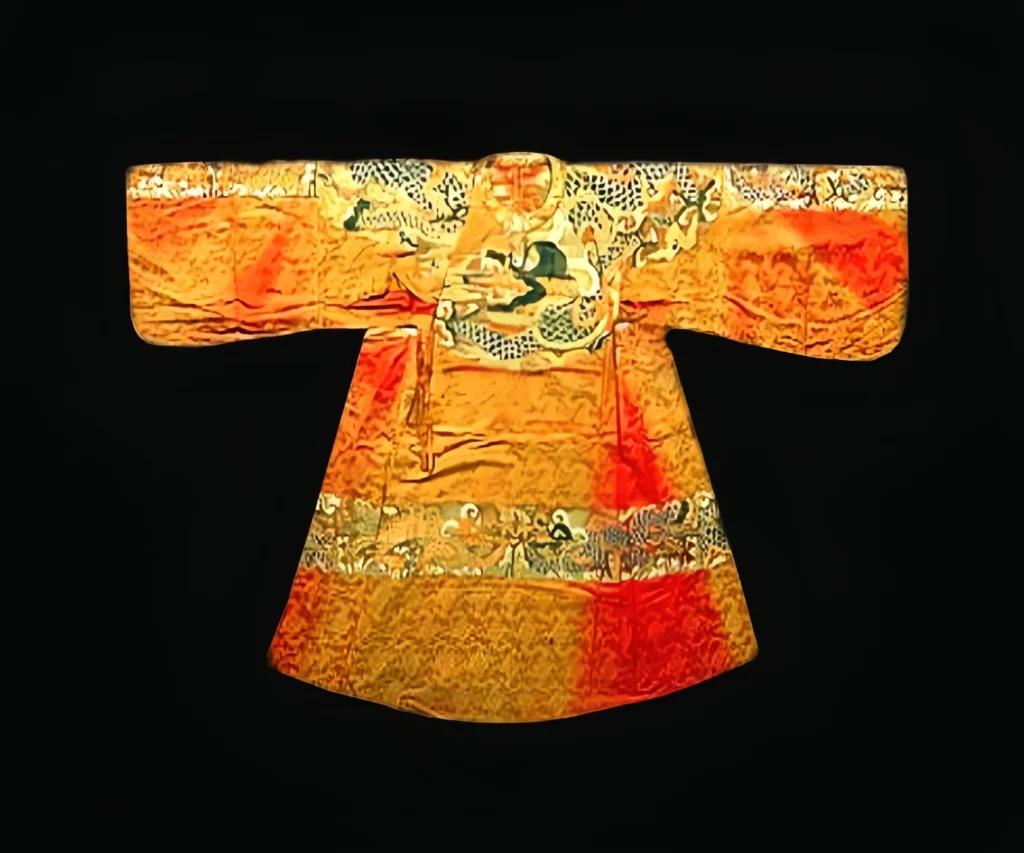
Type of Ming Bestowed Robes
(Ming dynasty clothing at its most exclusive)
The decorative patterns on these Ming bestowed robes are similar to the emperor’s dragon robes, and they were originally not part of the official rank system. Instead, they were special bestowed garments granted by the Ming court to eunuchs of the Imperial Secretariat and high-ranking ministers as marks of exceptional favor. Receiving such Ming bestowed robes was considered a great honor.
According to the Ming History · Treatise on Attire: In the thirteenth year of Zhengde, “all officials were granted one piece of bright red silk gauze. As for the garment colors: first rank received Dou Niu, second rank Flying fish robe, third rank Mang, fourth and fifth ranks Qilin robe, sixth and seventh ranks Tiger or Panther. Members of the Hanlin Academy and Remonstration officials received them regardless of rank; only clerks below fifth rank were excluded.”
Shen Defu wrote in Wanli Yehuo Bian · Supplement vol. 2: “The Mang robe resembles the dragon robe worn by the emperor, but with one less claw.” The Yuan Code, vol. 58, also records that in the first year of Dade (1297), “a report stated: ‘The satin being sold in the market looks just like the emperor’s own robes, decorated with great dragons, except missing one claw. The ones with four claws are being openly sold.’” This shows that four-clawed dragon-patterned hanfu robe—essentially Mang robes—were already available on the market in early Yuan times.
The Ming History · Treatise on Attire, describing eunuch garments, says that after the Yongle reign (after 1403), “eunuchs attending the emperor must wear Mang robes… embroidered Mang patterns on both sides, tied with a luan belt. Next in rank are Flying fish robe… Single-Mang robes show a pair of side-facing Mang on the left and right panels; Sitting Mang robes add a front-facing Mang on the chest and back, making them far more prestigious.
There were also those with a knee panel, similar to the Yesa (called Yesa in Sui Jin), with a Mang patch on the front and back, and a horizontal cloud-patterned Mang decoration at the knees for convenience when riding during suburban sacrifices or attending imperial funerals. Sometimes, when summoned for audiences or banquets, both emperor and ministers wore these instead of formal robes. Mang designs were divided into five-clawed and four-clawed, and knee panels came in red or yellow.”
From this account, we can see that Mang robes—the most dragon-like Ming bestowed robes—could have two side-facing Mang (single Mang), or front-and-back sitting Mang combined with side Mang (sitting Mang), which was more distinguished. The Yesa style was robe-skirt–like, with additional horizontal cloud-pattern Mang motifs at the knee area.
The Mang robe was a type of Ming bestowed robes, and wearing it required a jade belt. Because the Mang robe closely resembled the emperor’s dragon robe, it was never part of the regulated official attire but an imperial reward for eunuchs and favored ministers. Receiving one was considered a high honor. (Mang creatures resemble dragons, but differ in claw number—dragons have five claws, Mang creatures have four. Only the emperor and his relatives could wear five-clawed dragon robes. In the late Ming, some powerful ministers also wore five-clawed designs but called them “Mang dragons.”)


Flying fish robe, according to the Classic of Mountains and Seas, is described: “Its shape is like a boar with red markings; wearing it prevents lightning and grants protection in battle,” giving it a mythical quality. The Record of Linyi states: “The Flying Fish has a round body over one zhang long, with layered feathers and wings like cicadas.” It is a mythical creature with a dragon-like head, wings, and a fish tail—this hanfu robe version became second only to Mang in prestige.


Dou Niu (Fighting Ox) originally refers to a celestial constellation. The Book of Jin · Biography of Zhang Hua tells that during Emperor Hui’s time, Marquis Zhang Hua observed purple qi between the Dou and Niu stars.
He asked Lei Huan, who was skilled in astronomy, for interpretation. Lei said the qi came from the spirit of the famed sword of Fengcheng rising to the heavens, so he was appointed magistrate there. Upon taking office, he dug under the prison building and found a stone box containing two swords—Longquan and Taia. One was given to Zhang Hua, the other kept by Lei. After Zhang Hua’s death, the sword disappeared. After Lei died, his son crossed the river carrying the sword when it suddenly leapt into the water; two dragons were seen coiling and stirring the waves before vanishing with the sword.
In the Ming Dynasty, the Dou Niu robe—first-rank exclusive among Ming dynasty clothing—featured a bull-horned dragon creature.

The Qilin robe is a legendary creature shaped like a deer, covered in scales, with a cow’s tail and horse-like hooves, and a single flesh horn. Later representations gave it a dragon head with two horns and a lion-like tail. Qilin motifs became popular symbols of good fortune and were used widely in decorative arts. In Ming dynasty clothing, Qilin patterns appeared not only for fourth- and fifth-rank civil officials but also for certain elite military units such as the Embroidered Uniform Guard.
Ming officials’ attire included court robes, ceremonial robes, regular robes, and Ming bestowed robes. The Qilin robe, worn as court attire, featured a large front-opening design, diagonal collar, loose sleeves, and a horizontal band at the waist, below which pleats were gathered. Besides the front and back roundels, additional patterns appeared on the shoulders and below the waist. On the sides, a wide plain-colored panel called a bai was sewn. Liu Ruoyu, a Ming eunuch, described this hanfu robe in Zhuo Zhong Zhi: “The back panel is continuous, while both sides have bai; the front panel is split into two, and below are horse-face pleats starting from both sides.” Materials and motifs were regulated by rank.
The Ming History · Treatise on Attire states again: In the thirteenth year of Zhengde, “all officials were granted one piece of bright red silk gauze… First rank Dou Niu, second rank Flying fish robe, third rank Mang, fourth and fifth ranks Qilin robe, sixth and seventh ranks Tiger or Panther; Hanlin and Remonstration officials received them regardless of rank; clerks below fifth rank were excluded.”


Their main differences are that the Flying fish robe has fins, Dou Niu has bull-like horns, and the Qilin robe has hooves.
Love rare Ming dynasty clothing?
Check our Ming Hanfu styling guide!


Responses