Secrets Hidden in the Toes of Ancient Chinese Shoes


As one of the earliest civilizations to wear ancient Chinese shoes, ancient China developed a remarkably rich Chinese shoe culture—among which the “secrets hidden in the shoe tip” are especially fascinating…
Everyone knows that modern shoes are made for left and right feet. But if we turn the clock back just 100 years, ancient Chinese shoes shaped differently for each foot were still considered unusual. Ancient Chinese shoes that distinguished left and right were called yun jiao shoes in ancient times, and people simply did not wear them. For thousands of years, ancient Chinese shoes were made without separating left from right.
Why didn’t ancient Chinese shoes distinguish left and right feet? Although ancient Chinese shoes were not divided by foot, buying shoes still involved a sense of “left and right.” When trying on shoes, people usually tested the left foot first. If the left foot fit, there was no need to try the right. This is because the human left foot is generally slightly longer than the right—interestingly, the opposite of hands. In ancient times, some people were even known for having an unusually long left foot, such as Sun Shu’ao, prime minister of the State of Chu. Xunzi · Fei Xiang records him as having a “long left foot.”
Because ancient Chinese shoes were not left–right specific, only one shoe last was needed in shoemaking. In fact, this was also true elsewhere: Western shoes only began distinguishing left and right less than 200 years ago, starting in the United States in 1818. China’s first pair of left–right leather shoes was made in 1876 by Shen Binggen from Pudong, Shanghai. This shows how short the history of left–right ancient Chinese shoes really is.
Ancient Chinese shoes without left–right differentiation were also called zheng jiao shoes or zhi jiao shoes. Why were ancient Chinese shoes made this way? One reason may be the strong taboo against wearing mismatched “mandarin duck shoes.” In traditional thinking, a pair of shoes had to be identical. Wearing mismatched shoes was considered unclean and was associated with people of low status. This is completely different from modern fashion trends, where people may deliberately wear mismatched shoes to look edgy.
The phrase “black and white paths,” used to describe people with ties to both officials and outlaws, actually originates from these “mandarin duck shoes.” In ancient times, footwear was strictly regulated by social rank. During the Wei, Jin, and Northern and Southern Dynasties, even shoe colors were tightly controlled. Emperor Xiaowen of Northern Wei, whose clothing reforms deeply influenced Chinese dress culture, stipulated that soldiers and craftsmen could not wear shoes beyond green, blue, or white; servants could not exceed red or blue—violators faced execution. As for merchants, the Western Jin court required them to wear one white shoe and one black shoe. These mismatched shoes were precisely what was called “mandarin duck shoes.”
This black–white pairing was known as “black and white paths.” Because merchants were often seen as crafty and prone to colluding with officials, the term gradually evolved into its modern meaning.
Why Did Ancient Chinese Shoes Have Upturned Toes?
Although ancient people disliked mismatched shoes, they had no issue with mandarin ducks. Mandarins were seen as symbols of love, and embroidered mandarin duck motifs were commonly used on Hanfu shoes, especially after the Han and Tang dynasties. Women in particular favored such designs. Tang poet Linghu Chu wrote in Miscellaneous Songs · Farewell from Afar:
“Mandarin duck shoes woven with tortoiseshell, jade-green curtains trimmed with gold.”
The “mandarin duck shoes” here refer not to mismatched footwear, but to exquisitely made Hanfu shoes embroidered with mandarin ducks. Other motifs included phoenix heads, sparrow heads, and crouching doves, giving rise to names like “phoenix-head shoes” or “sparrow-head shoes.” Their shared feature was the upturned toe, known as shoe curl (xie qiao).
While the upturned toe was not unique to China, it became a defining feature of ancient Chinese shoes. Both men’s and women’s shoes had curled toes, differing mainly in shape—men’s more squared, women’s more rounded. This design appeared as early as prehistoric times. By the Han dynasty, a revolutionary split-toe design known as qi tou shoes emerged. Archaeological finds from Mawangdui in Changsha and Phoenix Hill in Jiangling reveal such double-pointed curled shoes. Even straw or hemp shoes later retained high curled toes.
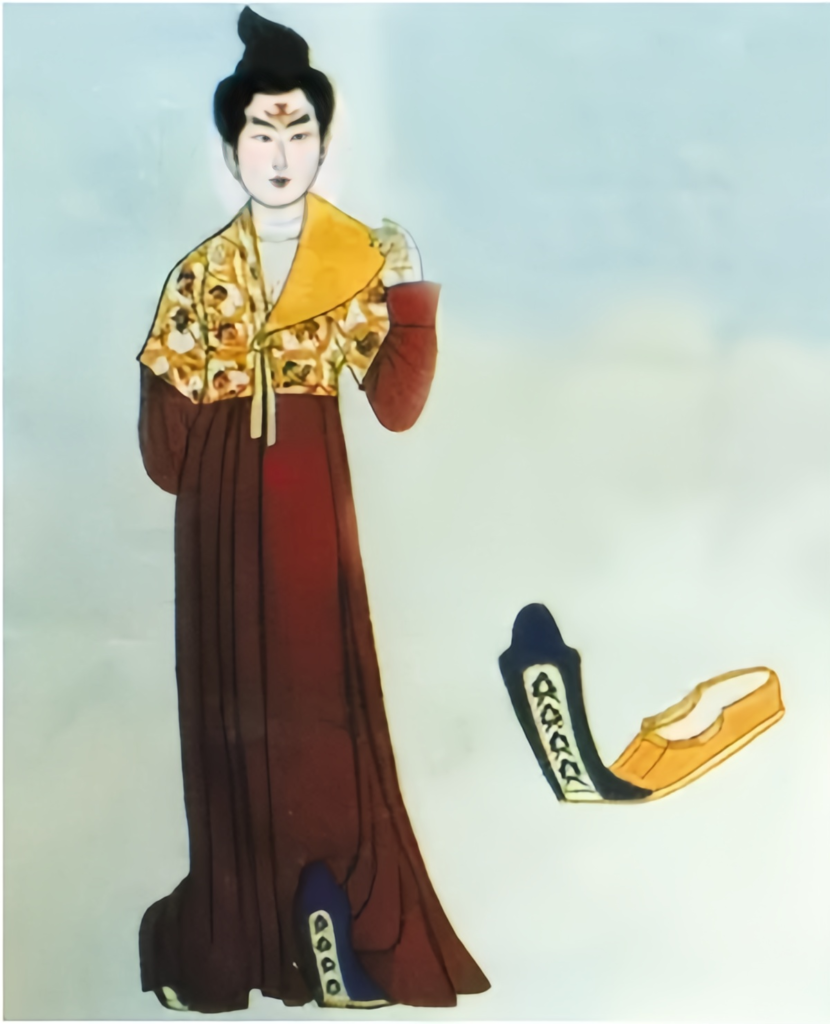
During the Sui and Tang periods, women’s shoes evolved mainly in toe design—round, square, pointed, petal-shaped, or layered—but all maintained high curls. These designs were highly symbolic. For example, luxury cloud-pattern shoes used white cloth for the body and blue cloth for the raised toe, with decorative strips symbolizing the twelve months of the year.
Even after foot-binding became common in later periods, the iconic “three-inch golden lotus” bound foot shoes still preserved the curled toe. Why was this detail so important? First, the curled toe strengthened the structure, making shoes more durable. Second, since people wore long robes, the raised toe helped lift hems and prevent tripping. Symbolically, an upturned toe suggested “rising step by step” and shared the same aesthetic logic as the upturned eaves of traditional Chinese architecture—light, elegant, and uplifting.
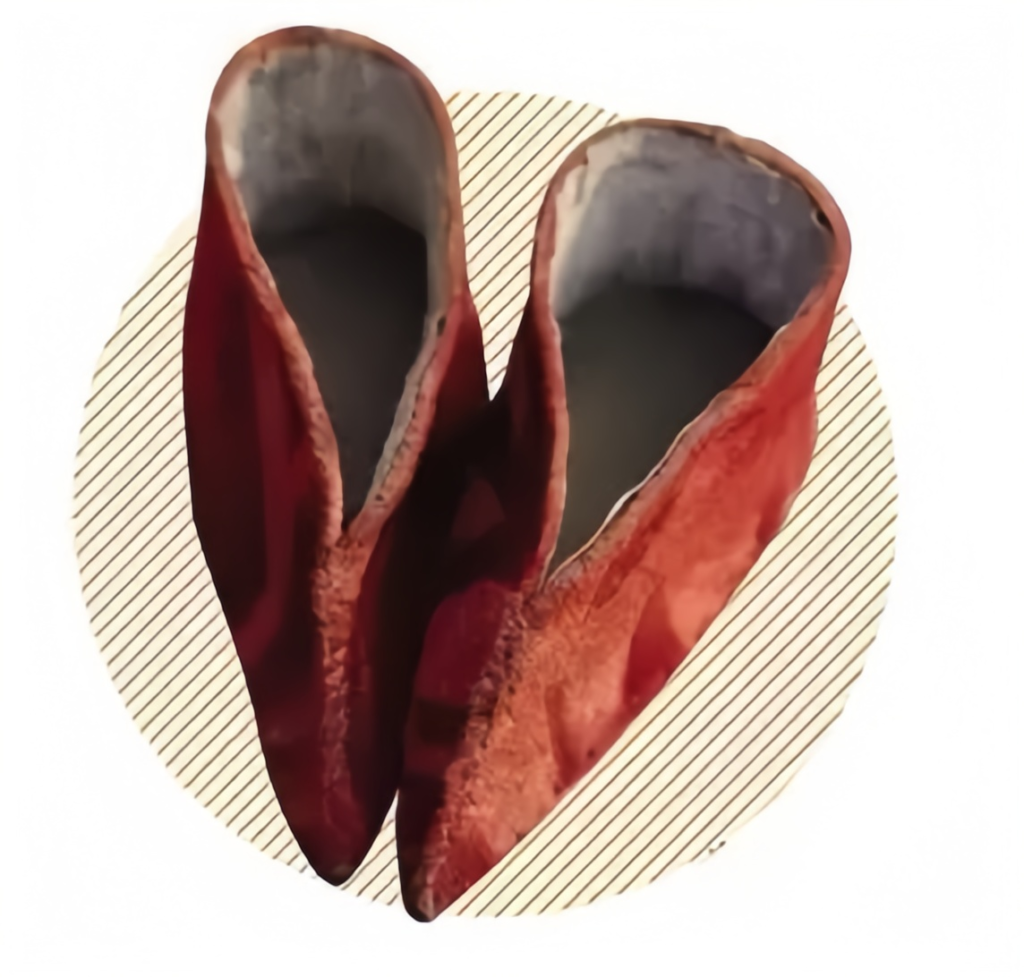
The curled toe also had a defensive function. Among Miao women in Guizhou, blades were sometimes hidden inside the shoe curl as protection against sexual assault.
Why Did the Poor “Borrow Clothes but Not Shoes”?
In ancient times, borrowing clothes was common among the poor, but borrowing ancient Chinese shoes was rare. Shoes were inexpensive—grass and hemp were enough to make them—so borrowing was unnecessary.
The term “broken shoe,” used to describe immoral women, has several origins. One explanation recorded by scholar Hu Kao suggests that prostitutes borrowed clothes but had to keep wearing their own worn shoes, hence the term. Another version traces it to Beijing’s Eight Great Alleys, where embroidered shoes were hung as signs for illicit services. Over time, these shoes became synonymous with moral disgrace.
Others argue that “broken shoe” stems from ancient sexual symbolism. In traditional belief, shoes symbolized female sexuality and fertility. This may relate to the legend of Hou Ji, ancestor of the Zhou dynasty, whose mother Jiang Yuan conceived him after stepping on a giant footprint.
For ancient women, shoes were closely tied to marriage and love. Embroidered shoes—often considered “Chinese shoes” today—were used as love tokens and symbols of good fortune, especially during the Tang and Song periods. Also called flower shoes, they were said to originate with Duke Xian of Jin, who required palace women to embroider floral motifs on their shoes and mandated such shoes for brides.
Shoe Divination in Ancient Times
Shoes were also used for divination, known as shoe divination. Although it seems superstitious today, it was popular among ancient women, especially those with bound feet. Women used shoes to predict whether and when their husbands or lovers would return, judging the outcome by the direction of the shoe’s toe and opening.
This practice also appeared among ethnic minorities. Among the Yao people of Guangxi, couples each made a wooden clog; if the pair matched, the marriage was approved by fate. Among the Miao, brides wore handmade straw shoes to divine their marital future, examining wear patterns after returning from their husband’s home.
By observing which part of the sole wore out first, they believed they could foresee fortune or hardship in life.
These small details reveal how deeply shoes were woven into daily life, belief, symbolism, and emotion in Chinese shoe culture—far beyond simple practicality.
Want to explore more Chinese shoe culture?
Check our Chinese Footwear Guide for authentic tips!

Responses