3 Most Popular Types of Hanfu Styles and Their Rich History


Hanfu, also known as Han clothing or Han attire, refers to the traditional clothing of the Han Chinese people. It’s important to note that Hanfu doesn’t specifically refer to clothing from the Han Dynasty but rather to a broader tradition of clothing that evolved over centuries. In ancient China, clothing held great significance, not only serving practical functions like warmth and decoration but also representing cultural and political meanings. There are various types of Hanfu, each with its own unique design and historical context. These Hanfu styles reflect different periods and cultural shifts, showcasing the richness and diversity of traditional Chinese clothing.
- Yichang Style (衣裳制) – A two-piece outfit with a separate top and bottom, a classic Hanfu style that has been passed down through generations.
- Shenyi Style (深衣制) – A one-piece garment made by sewing the top and bottom together, another key type of Hanfu that has significant historical and cultural importance.
- Pao Fu Style (袍服制) – A seamless garment where the top and bottom are cut from a single piece of fabric, naturally forming a unified piece, representing one of the most elegant Hanfu styles.
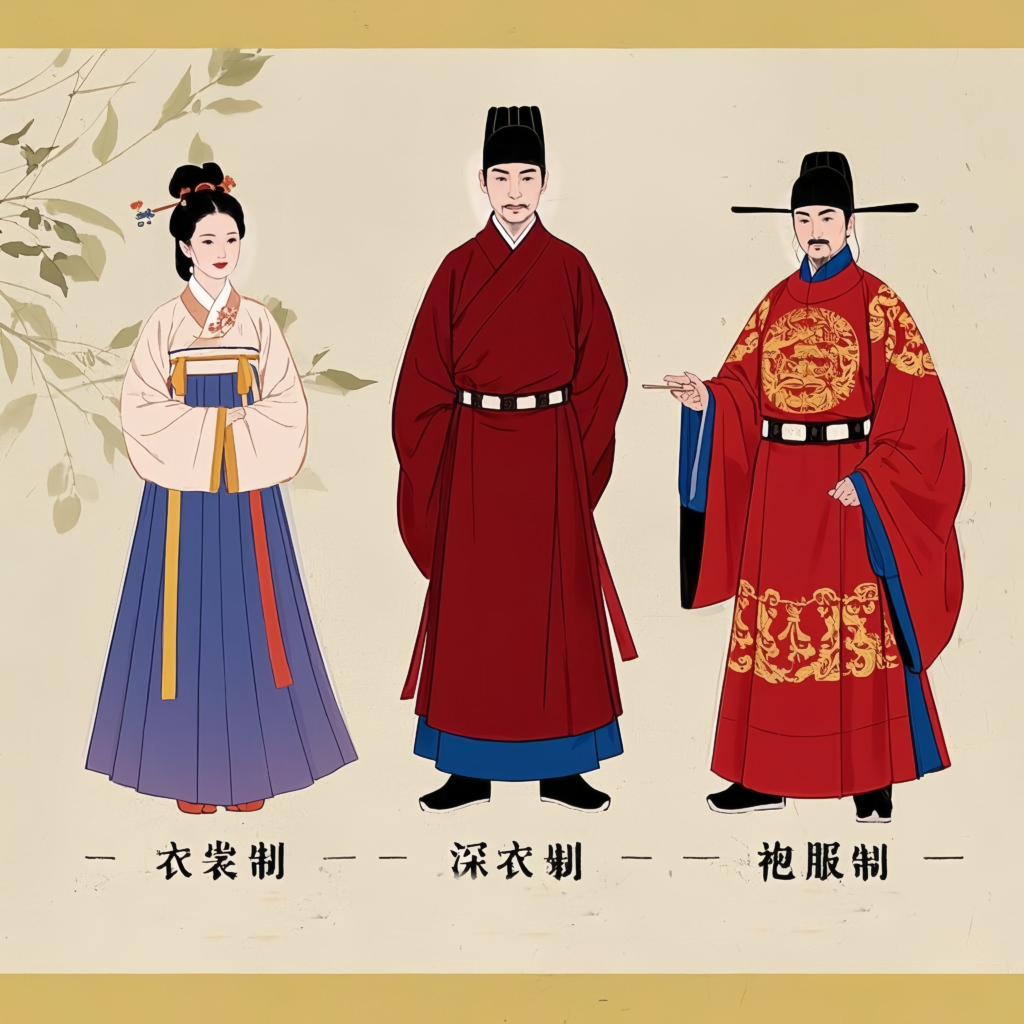
Below, we’ll take a closer look at some classic Hanfu styles based on these three fundamental clothing forms.
Yichang System (衣裳制)
Ruqun (襦裙)
The Ruqun, consisting of a short upper garment (called “Ru”) and a skirt (called “Qun”), first appeared during the Warring States period and became popular during the Wei Jin and Northern and Southern Dynasties. As one of the types of Hanfu, the Ruqun remained a prominent choice for women well into the Ming Dynasty and the beginning of the Qing Dynasty, with common women continuing to wear it as daily attire.
- The upper garment, the “Ru,” is typically shorter than the knees, while the skirt, the “Qun,” is longer. The combination of the two garments reflects the union of two distinct Hanfu styles.
- Depending on the waistline, there are variations of the Ruqun, such as waist-level, high-waisted, and chest-level Ruqun.
- The collar style also varies and can be a cross-collar, straight collar, or round collar.
展示图-1024x1024.png)
Aoqun (袄裙)
The Aoqun refers to a type of Hanfu worn by women in ancient China, where the upper garment is a jacket (called “Ao”) and the bottom is a skirt. This Hanfu style is typically associated with the Ming Dynasty.
- The Ao can come in four different collar styles: straight, round, upright, or square.
- The skirt varies by dynasty. For instance, the Tang Dynasty often used a piece of fabric cut into a trapezoidal shape for the skirt, while the Song Dynasty favored pleated skirts, and the Ming Dynasty commonly wore “Horse-face skirts,” characterized by pleats and a unique structure.
图片详细描述-1024x1024.png)
Shenyi System (深衣制)
In the Spring and Autumn and Warring States periods, one of the most popular types of Hanfu was the Shenyi, which had a distinctly closed design. Although the exact Hanfu styles varied, they all served to envelop the body entirely.
Zhi Ju (直裾)
Zhi Ju, a form of deep clothing (shenyi) in Hanfu, features a straight-cut hem, and there are no decorative borders or edges on the garment. The garment is typically fastened with cloth or leather straps.
- In the Han Dynasty, Zhi Ju was worn by both men and women but wasn’t considered formal attire. This was because the pants at the time did not have a crotch area but rather two separate legs up to the knees, held up by a belt. If not covered by an outer garment, the pants would be exposed, which was considered disrespectful.
- With improvements in undergarments over time, the Zhi Ju gradually became a formal and typical style for deep clothing.
展示图-1024x1024.png)
Qu Ju (曲裾)
Qu Ju, another traditional Hanfu style from the Qin and Han periods, is a tight-fitting garment with a curved hem that typically reaches the ground. The design is narrow, and the lower edge flares out like a bell, covering the feet.
- The Qu Ju is recognized for its elegant wrap-around design and has wide or narrow sleeves, most of which have a rolled edge.
- The Qu Ju became popular due to its practicality and the respect it commanded in ceremonies, especially with its good wrapping ability that reflected proper etiquette. It remained common from the pre-Qin era through the Han Dynasty.
展示图-1024x1024.png)
Pao Fu System (袍服制)
Yuanling Pao (圆领袍)
The Yuanling Pao, or round-collar robe, is a traditional Hanfu style common across East Asia, including China, Japan, and Korea. This style features a round neckline and a buttoned closure, making it both practical and elegant.
- During the Sui and Tang Dynasties, the Yuanling Pao underwent significant development. It was comfortable to wear, with wide sleeves that allowed ease of movement.
- Both men and women wore the round-collar robe, though men typically wore plain-colored versions without patterns, while women’s robes were more colorful and often decorated with intricate designs.
- After the Song Dynasty, the round-collar robe became a standard garment for officials, and by the Ming Dynasty, it had evolved into a marker of social status, with the fabric used indicating one’s rank in society.
展示图-1024x1024.png)
Feiyu Outfit (飞羽套装)
The Feiyu outfit, known for its flying fish patterns, is a ceremonial robe that belongs to the Hanfu styles worn by high-ranking officials during the Ming Dynasty. The “flying fish” is not a typical sea fish but a mythical creature with a dragon’s head, fish body, and wings, which symbolizes power and authority in Chinese culture.
- This outfit was a formal and ceremonial garment, worn by high-ranking officials such as senior eunuchs and members of the Jinyiwei (a specialized intelligence agency during the Ming Dynasty).
- It was a rare, highly ornamented attire used only for special occasions, representing the highest status and royal authority.
-1024x1024.png)
Conclusion
The rich variety of Hanfu styles demonstrates the deep cultural and historical significance of traditional Chinese clothing. Whether it’s the Yichang system, the Shenyi system, or the Pao Fu system, each type of Hanfu carries its own historical context and societal meaning. These garments, classified into various types of Hanfu, are not only symbols of aesthetic beauty but also represent cultural heritage, political power, and social norms of their respective times. Today, Hanfu continues to be a popular choice for those interested in Chinese culture and history, offering a glimpse into the elegance and refinement of ancient China.
For more insights into Hanfu and its historical significance, check out this external link.


You have made some decent points there. I looked on the internet for additional information about the issue and found most people will go along with your views on this site.